Your Team Had a Meeting. Did Anyone Actually Get Support?
There is a particular quiet that settles over a team after something terrible happens at work. Hallway conversations drop to half volume, people get kinder to each other and somehow further away at the same time, and somewhere in the middle of it, someone schedules a meeting.

Maybe you've sat in that meeting. Maybe you've led it. Either way, you may have walked out feeling strangely worse, or simply emptier, and not been able to explain why.
Here's one reason: a meeting is not the same thing as support.
After a traumatic event at work, most teams get a meeting. Far fewer receive the kind of support that actually helps people process what happened and stay connected to one another afterward.
As a trauma psychologist, I've spent years supporting clinicians and trauma-exposed teams after critical incidents. I've facilitated debriefs, consulted with leadership, supervised providers, and sat with teams in the immediate aftermath of difficult events.
What I've learned is this:
Real support after a traumatic event is not a single conversation. It's the trust, safety, and connection that exist before the event, are strengthened during it, and continue long after the meeting ends.
When a Debrief Stops Being Support
Many organizations treat a debrief as the place where everything happens.
People gather in a room, the event gets reviewed, questions get asked, lessons get identified.
On paper, it sounds reasonable.
The problem is that many debriefs are trying to accomplish two completely different goals at the same time.
One goal is operational:
What happened?
What contributed to it?
What needs to change?
How do we prevent it from happening again?
Those are important questions.
The other goal is human:
How is everyone doing?
What are people carrying?
What impact did this have?
What support is needed now?

Those questions are equally important. But when organizations combine these conversations into a single meeting, people often stop feeling safe enough to answer either set honestly.
The moment a room senses that blame, liability, performance evaluation, or organizational protection are part of the agenda, vulnerability disappears.
I've watched it happen.
Questions land in silence, people become cautious, supervisors do most of the talking while everyone else quietly decides that honesty carries too much risk.
And a debrief where people don't feel safe enough to be honest cannot provide the support it was intended to offer.
Why do so many debriefs leave people feeling worse?
Because a one-off debrief with no relationship behind it can do more harm than good, and support depends on the trust that already exists in the room.
I learned this early, working with other clinicians at a level one trauma center, where being new and a stranger to them meant it did not matter that I was the hospital's trauma psychologist or how sharp my questions were. I was an unknown person walking into a room full of helpers wired to protect themselves, their work, and each other, and that protectiveness is not a flaw but the very thing that keeps people standing in hard jobs, even as it made the silence thick enough to cut glass.

With the teams I had time to build with, the ones who grew to know me, something else became possible, and people let themselves be seen in a way no technique of mine could have produced, since the difference was never my skill in the room but the trust we had spent real time building.
The research on debriefing the people who do this work points the same direction. A2023 scoping review in Frontiers in Psychiatryfound that debriefing was built, for most of its history, to improve clinical outcomes and team learning, with the emotional wellbeing of the staff themselves barely studied at all, and the same review reports that the practices used most often, single sessions with no follow-up, are among those concluded to be detrimental to staff wellbeing (Evans et al., 2023).
Researchers even have a name for the clinician who is wounded when something goes wrong, the second victim, though it is a debated term, since calling a clinician a victim can blur accountability and can land painfully for those most directly harmed (Vanhaecht et al., 2022; Tumelty, 2021).
So if a debrief at your workplace has felt hollow, that is not a personal failing, yours or your leader's, but what tends to happen when a one-time meeting is asked to carry the weight of an ongoing relationship.
What does real support after a traumatic event at work actually look like?
Real support is a shared practice: the clinician names what happened and that they are affected, and the leader meets it honestly and names it for the team.
If you were the one in the room, the first move is to call a thing a thing, to name what happened out loud, first to yourself and then to someone who can do something with it, and to let yourself be affected without reading that as failure, since being affected is information and it is human.
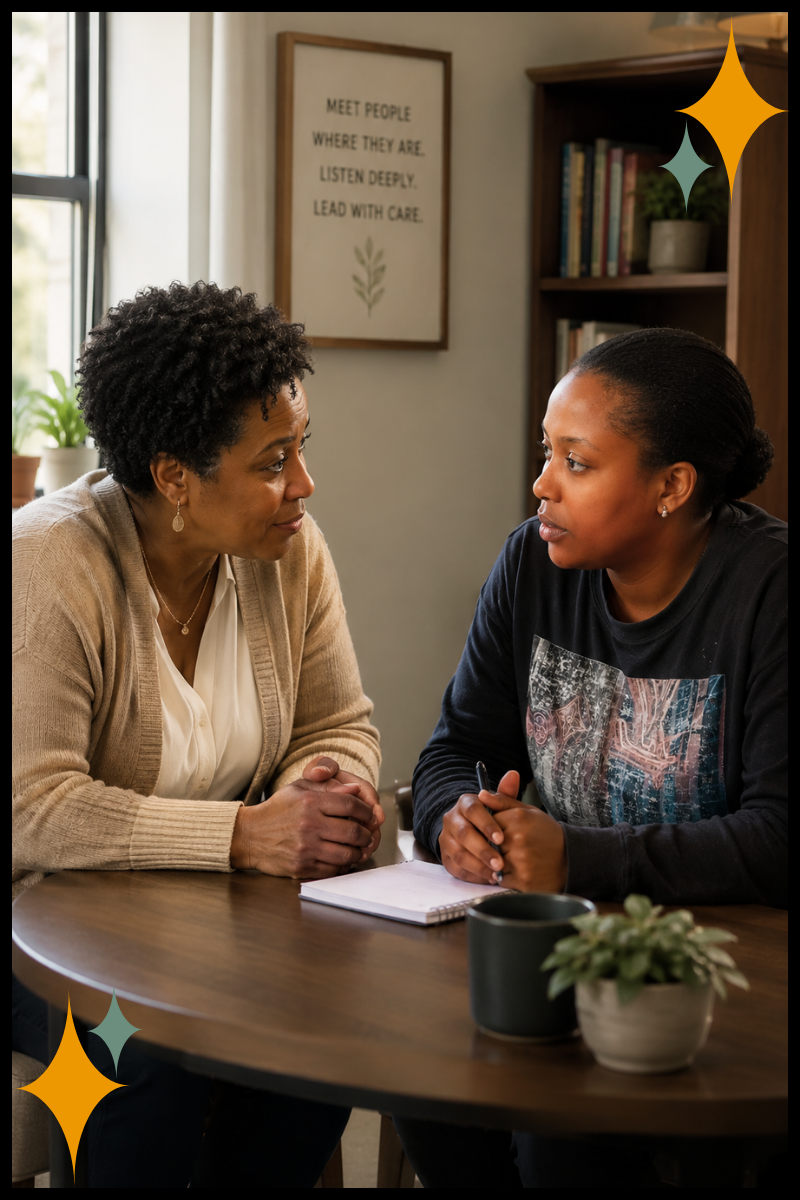
When you need the words for your supervisor, you are welcome to borrow mine: what happened last week is still with me, and I need us to talk about it as a team, not just keep going.
Leaders, your move is the other half of the same act, so when someone brings you that, meet them instead of managing them: that was awful, and it makes sense that you are still feeling it, because you are human first. Then name it for the team, since one person being brave enough to say it is still sitting in their body almost always means the rest are feeling it too, and a leader who says plainly this happened here, and we are going to talk about it is often offering the most validating thing a team has heard.
Set the frame as you do it, naming that this is not a review of who got it wrong and not a conversation about the next lawsuit, but a space made for the people who were actually in it.
Both moves point the same way, since the clinician naming her experience and the leader naming what happened are one act from two directions, what Brené Brown calls clear is kind, and the truth underneath it is that avoidance feels safer in the moment while it quietly eats away at trust, where honesty offered with care is what lets people keep doing the work they love.
It is not on the clinician alone to be brave, and not on the leader alone to hold everyone, since the practice only does its work when it is genuinely shared.
How do you build the trust support depends on?
You build it before you need it, in the ordinary weeks, long before a crisis arrives.
Safety cannot be manufactured in the ninety minutes after something terrible, so whatever you built before the incident is what you have to work with after it, and that building is the quiet, unglamorous work of co-regulation, connection, and communication, the three habits that hold a team together when an extraordinary day finally comes.

The connection you tend to on an ordinary Tuesday turns out to be the same connection that holds the whole room later.
The one move worth making today is to stop waiting for the next hard thing before building what makes it survivable, whether that is the handful of colleagues you have chosen as your people or the whole team you lead, and to begin while it is calm rather than reaching for trust in the moment you discover it was never there.
Being human about what happened was never the soft part of this work, it is the part that keeps good people in it, and it is worth holding onto the truth that you are a human first and a trauma therapist, helper, and healer second.
What’s Next?
If you want a place to start noticing how this work is landing in your own body, my free Vicarious Trauma Tracker was built for exactly that.

And if reading this surfaced the ache of doing the work too alone, that is the whole reason BRAVE exists, and the BRAVE Trauma Therapist Collective is where trauma therapists come to be human together, between the hard days and not only after them.
If you are the one thinking my whole team needs this, The BRAVE Method is how I help a team and its leadership build that foundation together, so the trust is already in the room when something happens