
One shared framework for trauma-exposed teams, taught to leadership and providers together.
A skills-based, evidence-informed training where leadership and providers learn together, with outcome measurement built in.
See how it works ↓Your team snapshot
Trauma-exposed teams strain in predictable, well-documented ways, and the effective responses are organizational.
The next step is a shared framework with measurement behind it.
The training applies across roles and settings, customized to your team.
Your result below maps where your organization fits.
Two free tools you can use with your team this week, whatever you decide about training. The Vicarious Trauma Tracker and the Vicarious Resilience Tracker.
What the research says about what you're seeing
Sustained trauma exposure affects providers in predictable ways, and organizations feel it in turnover, morale, and quality of care.
Whatever brought you here, the pattern responds to the same things, a shared framework applied by the whole team and measured over time.

"My staff are telling me they're burned out."
you are far from the only leader saying itOne supervision moment, before and after.
The BRAVE Method is a three-part framework, Name It, Tame It, Reframe It, that your whole team learns in one half-day training. Here is what it sounds like inside one ordinary Monday check-in. Each button shows the usual reply first, then the same moment with the framework. The dialogue is illustrative; the training works with your team's real conversations.
That shift took you three clicks. Your team leads learn to make it in live conversations, in one training day, with a shared language that keeps working long after the workshop ends.
Individual supports help, and the gap sits at the team level.
Individual supports do their job, and the research consistently ties burnout and vicarious trauma to organizational factors such as workload, supervision quality, and culture (Sutton et al., 2022). This training responds at that level.
Here is the center of it, stated plainly. vicarious trauma comes with being human in this work, and so does vicarious resilience. The BRAVE Method trains a team to work with both, together and on purpose.
The usual approach
- Wellness benefits and EAP, reaching individuals one at a time
- Supervision focused on cases and compliance
- Support that depends on individual capacity
- Hiring to replace rather than retain
The BRAVE Method
- One shared language for vicarious trauma and vicarious resilience
- Practices embedded in existing team routines (supervision, meetings, and so on)
- Support the whole team carries with each other
- Outcomes measured at baseline, 6, and 12 weeks
name it, tame it, reframe it
The BRAVE Method organizational training
The BRAVE Method is a skills-based, evidence-informed training designed for leadership and providers to learn together, addressing the disconnect between trauma-exposed work and the support structures, leadership routines, and team culture that sustain it.
The training is customized to your roles, setting, and context while the core framework stays intact.

The organizational intake
After you book your training, you'll schedule a one-hour conversation with Jenny for leadership and whoever is coordinating. Together you'll walk through your organization's goals, strengths, and areas of growth, and start mapping how The BRAVE Method fits into your current systems. Your training is customized to your providers before anyone steps into the room.
Baseline next
Your team completes two brief measures before the training, the ProQOL and the BRAVE Implementation and Team Support Check-in. You will know exactly where you're starting.
The training day
Leadership and providers learn Name It, Tame It, Reframe It together, through team-based reflection and exercises your team can adopt as shared rituals and supervision practices.
Measured follow-through
The same measures run again at six and twelve weeks, with aggregate reporting your leadership can plan around. The BRAVE team handles administration and scoring, and individual responses stay confidential.
Everything your team walks away with
The training session
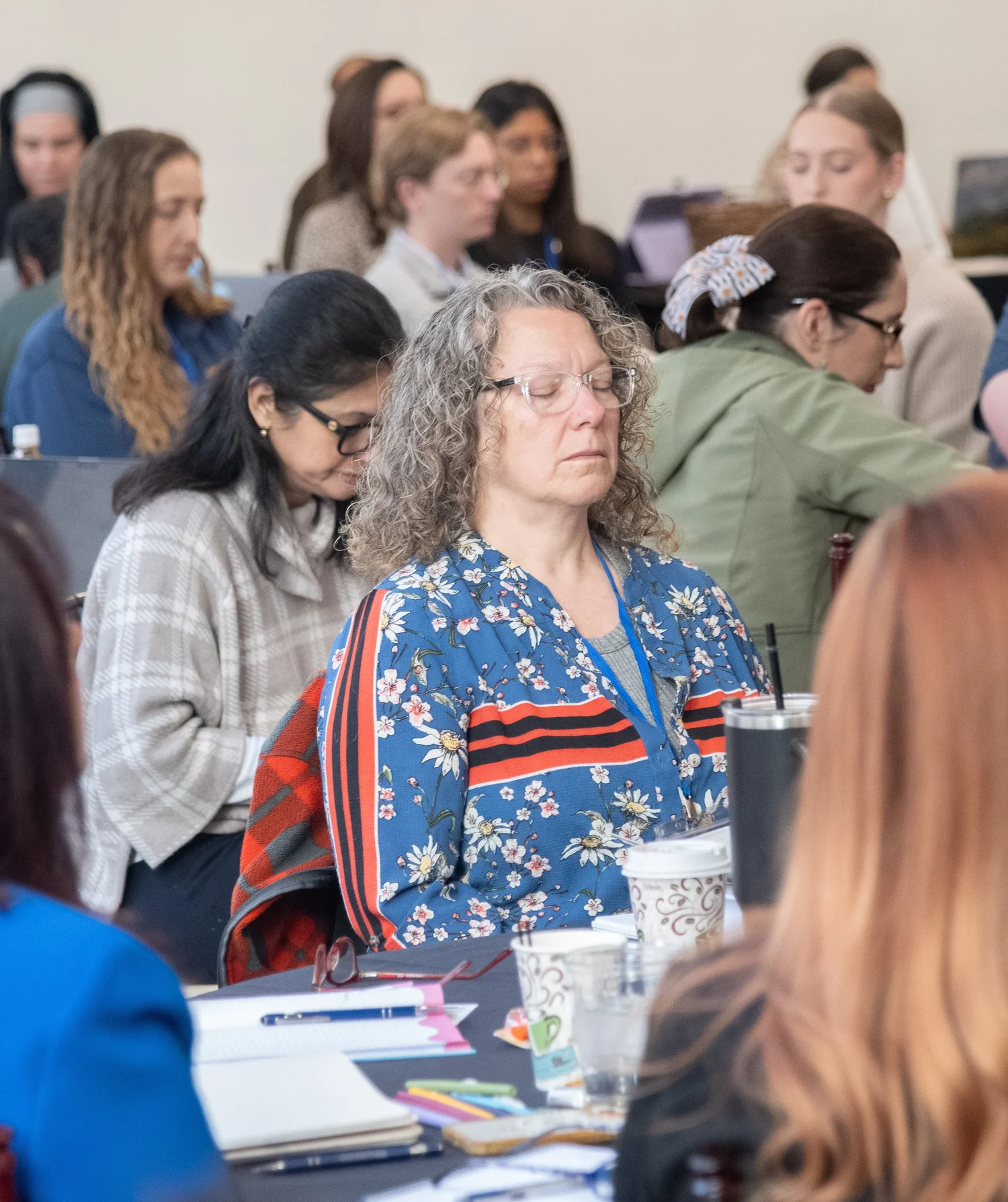
A half-day training where leadership and providers learn the framework together. Highly interactive, built to move past discussion into practical application, with exercises your team adopts as shared rituals and supervision practices.
The BRAVE Method framework
Name It, Tame It, Reframe It: identify vicarious trauma and how it shows up across individuals and systems, learn practical strategies to respond in real time, and actively strengthen vicarious resilience, the mechanism that keeps teams engaged, connected, and effective over time.
Outcome measurement, handled for you
ProQOL and the BRAVE Implementation and Team Support Check-in at baseline, six weeks, and twelve weeks. The BRAVE team runs administration, scoring, and secure data management; your organization receives aggregate results and trends.
Customization to your setting
Customization begins with the organizational intake. Before your training date, leadership and whoever is coordinating sit down with Jenny for an hour to walk through your goals, strengths, and areas of growth, and how The BRAVE Method fits into your current systems. The core framework stays intact while cases, examples, and team practices are shaped to your roles and context, whether your team is clinicians, advocates, case managers, responders, or educators.
What organizations can expect
The training targets the organizational factors research ties to burnout and vicarious trauma, and the measurement shows you whether it's moving.
The evidence · organizational efforts have been shown to reduce secondary traumatic stress over time (Sprang, Lei, and Bush, 2021).
Shared language strengthens peer support and leadership alignment, so support stops depending on any one person's capacity.
The evidence · peer support networks are among the organizational factors that protect trauma-exposed staff (Sutton et al., 2022).
Providers and leads gain a way to name vicarious trauma and respond in the same conversation, inside meetings that already exist.
The evidence · a culture that acknowledges and validates vicarious trauma is protective in its own right (Sutton et al., 2022).
The training's primary focus is vicarious resilience, spotting it in real time and reinforcing it through supervision, peer support, and daily workflow.
The evidence · vicarious resilience develops through the same empathic engagement that produces vicarious trauma, and it is measurable (Hernández et al., 2007; Killian et al., 2017).
Hover over a card, or tap it, for the research behind each outcome.
What turnover already costs, per year
Gallup places the cost of replacing one employee at half to two times their annual salary. Set the sliders to your team's reality, and bring the result to your budget conversation if the decision runs through a board.
The multiplier range of half to two times salary comes from Gallup (2019). Behavioral health turnover averaged 31.3 percent in a 2022 survey of 471 facilities, and the peer-reviewed literature describes it as chronically high (Brabson et al., 2020). Full citations sit in the questions section below.

Jenny Hughes, PhD
Trauma psychologist, Assistant Professor at LSUHSC and UTHealth Houston, and author of The PTSD Recovery Workbook and Triggers to Glimmers. Jenny founded The BRAVE Trauma Therapist Collective, where trauma therapists practice this framework every week.
She is trained in EMDR, Brainspotting, and Cognitive Processing Therapy, formally trained in Dare to Lead™, and built The BRAVE Method from vicarious trauma and vicarious resilience research plus years in Level One Trauma Center, outpatient, and telehealth settings. She has trained teams and audiences for the Houston Psychological Association, the Florida Counseling Association, TraumaTALKS, and TPN.health, among others.
What leaders and organizers say
Inviting Jenny as a speaker was such a positive experience that we have invited her back to do a full day workshop! She was responsive and communicative during the planning stage and presented a great workshop that got positive feedback.
"We are so grateful to Jenny for helping us in our mission to educate professionals who serve children. The positive feedback we received shows your presentation was a true highlight of the conference."
"Jenny is an absolute gem. She is able to break down complicated topics and deliver them with ease. She is approachable, authentic, and warm and so passionate about creating safe spaces for trauma clinicians to support one another."
Three ways into The BRAVE Method
Every path starts from the same framework, one shared way to recognize vicarious trauma and strengthen vicarious resilience.
Core Training
half day · whole team
A half-day, whole-team training with outcome measurement built in.
- The organizational intake, a one-hour planning conversation with Jenny before your training date
- Half-day session, leadership and providers together
- The full Name It, Tame It, Reframe It framework
- ProQOL + team check-in at baseline, 6, and 12 weeks
- Administration, scoring, and reporting handled for you
- Customized to your setting and roles · CE eligible
The Full Day
Core + Leadership Implementation Training · 6 months support
Your whole team trains, your leaders train, and six months of customized follow-through holds it.
- The organizational intake, a one-hour planning conversation with Jenny before your training date
- Everything in the Core Training
- The Leadership Implementation Training for your executives, HR, and supervisors
- Six months of monthly implementation consultation, in leadership groups of up to ten
- Trauma-informed leadership, per the systems approach
- Implementation embedded in supervision and policy
Leadership Implementation Training
3 to 4 hours · leadership · 6 months support
Follow-through for teams that have already trained on vicarious trauma together.
- The organizational intake, a one-hour planning conversation with Jenny before your training date
- Leadership training for your executives, HR, and supervisors
- Trauma-informed leadership, per the systems approach
- Six months of monthly implementation consultation, in leadership groups of up to ten
- Built for teams with the core BRAVE Method training as their foundation
Every path starts from the same framework, and the measurement shows you what it did.
What the work gives back
Most trainings only track what the work takes from your providers. The BRAVE Method also tracks what it gives back. Researchers call it vicarious resilience, the meaning, growth, and connection that come from witnessing people recover. It's real, it's measurable, and organizational support is one of the things that strengthens it (Hernández et al., 2007; Killian et al., 2017; Sutton et al., 2022).
Every path below trains your team and your leaders to strengthen it on purpose, and the measurement tracks compassion satisfaction alongside the strain, so you see both sides.
What the six months of follow-through includes
The six months in the Full Day and the Leadership Implementation Training follow the model the implementation research supports, training plus ongoing consultation (Aarons et al., 2009; Williams & Beidas, 2018). It includes
- monthly implementation consultation with Jenny for your leaders and supervisors, in groups of up to ten, with up to two groups included
- workbooks and tools built specifically for your organization, with next steps
- clinical support and consultation between sessions as questions come up
- a final aggregate report and a data review call, so the six months ends with a plan built from your own numbers
The data shapes it as we go. If your supervisors need more support, we build more there. If team practices are holding, we reinforce what's working. Larger leadership teams add consultation groups, scoped on the call.
Possible next steps
Start with the core BRAVE Method training. The six- and twelve-week data will show where follow-through needs structure of its own, and adding the Leadership Implementation Training then is a natural extension. Nothing about that decision needs making today.
The call carries no obligation. It is a working conversation about your organization with a clear recommendation at the end, including a no if the fit is wrong.
Book a call with Jenny
A working conversation about your organization, who you serve, who's on your team, what they're carrying, and what you've tried, with a clear recommendation by the end. Booking the call commits you to the conversation and to nothing else.
If the scheduler doesn't load, book directly at tidycal.com/1wn5lr1/the-brave-method-discovery-call.
Fair questions, straight answers
These come up on nearly every call, so here are the answers up front.
"Will this actually change anything?"
That question is why measurement is built in, with the ProQOL and a team check-in at baseline, six weeks, and twelve weeks. You'll see in the data whether it's holding, and so will we. Any training unwilling to measure is asking you to hope.
"We can't afford it right now."
Budget pressure is real in every organization this training serves, which is why the scope and the cost are fixed up front. It is a half day at $2,500 with baseline and follow-up measurement included, so whatever you invest gets tracked rather than hoped about. And if now is the wrong time, the call will tell you that plainly.
"My team doesn't have room for another training."
The session is a half day, once. The practices it installs live inside the meetings and check-ins your team already holds, so the follow-through costs attention rather than additional calendar time.
"What if naming all of this opens something we can't close?"
Naming it with a trauma psychologist in the room, inside a structured framework, is what makes the conversation workable. Your providers are already carrying this. The training gives the whole team a way to address it with skill, together.

Questions? Answered.
What happens after I book the call?
You'll talk with Jenny about your organization, who you serve, who's on your team, what they're carrying, and what you've tried. You'll leave with a clear recommendation and logistics. If the fit or timing is wrong, she'll say so. When you decide to move forward, the organizational intake comes next, a one-hour conversation for leadership and whoever is coordinating, held before your training day so the work arrives already customized to your organization.
Does this apply outside of mental health?
Yes. The BRAVE Method is built for any helping profession with sustained trauma exposure, including child advocacy, victim services, healthcare, education, first response, and social services. The training is customized so your team works with examples from their own roles.
I'm not the only decision-maker. How does that work?
After the call you get a shareable summary covering scope, cost, and how outcomes are measured, and Jenny will join a follow-up call with other decision-makers if that helps the decision.
Can our staff earn CE credits?
Yes, the training is CE eligible. The approval logistics vary by organization, and Jenny maps that path with you on the call.
How is the training tailored to us?
Tailoring starts with the organizational intake, where leadership and whoever is coordinating meet with Jenny before the training date to cover your goals, strengths, and areas of growth, and how The BRAVE Method fits into your current systems. The core framework stays intact while the cases, examples, and team practices are shaped around your setting and roles, informed by the intake and the baseline data.
What does our team see of the assessment data?
Individual responses stay confidential, full stop. The BRAVE team handles administration, scoring, and secure data management, and your organization receives aggregate trends only.
How soon could our training happen?
Jenny delivers two organizational trainings per month, and dates get held on the call. The organizational intake and baseline data collection both happen between booking and your training day.
Where does the research on this page come from?
The claims on this page draw on the peer-reviewed literature on vicarious trauma, vicarious resilience, and workforce turnover. Key sources, with links where publisher pages are available.
Sutton, Rowe, Hammerton, and Billings (2022), systematic review of organizational factors in vicarious trauma. European Journal of Psychotraumatology.
Bell, Kulkarni, and Dalton (2003), organizational prevention of vicarious trauma. Families in Society.
Hernández, Gangsei, and Engstrom (2007), vicarious resilience. Family Process.
Engstrom, Hernández, and Gangsei (2008), qualitative investigation of vicarious resilience. Traumatology.
Hernandez-Wolfe, Killian, Engstrom, and Gangsei (2015), vicarious resilience and vicarious trauma coexist. Journal of Humanistic Psychology.
Killian, Hernandez-Wolfe, Engstrom, and Gangsei (2017), the Vicarious Resilience Scale.
Leung, Schmidt, and Mushquash (2023), personal trauma history and secondary traumatic stress. PubMed.
Sprang, Lei, and Bush (2021), organizational efforts and secondary traumatic stress. American Journal of Orthopsychiatry.
Aarons, Sommerfeld, Hecht, Silovsky, and Chaffin (2009), ongoing consultation during implementation protects against staff turnover. Journal of Consulting and Clinical Psychology.
Williams and Beidas (2018), organizational culture and clinician retention during evidence-based practice implementation. PLOS ONE.
Brabson et al. (2020), workforce turnover in community behavioral health. Clinical Child and Family Psychology Review.
OPEN MINDS (2022), turnover at behavioral health facilities averaged 31.3 percent across 471 surveyed organizations. OPEN MINDS.
Gallup (2019), replacing an employee costs one-half to two times their annual salary. Gallup Workplace.
Office for Victims of Crime, the Vicarious Trauma Toolkit and VT-ORG. ovc.ojp.gov.
McCann and Pearlman (1990), the original framework for vicarious traumatization. Journal of Traumatic Stress.
Give your team a shared way to carry this work.
One conversation about your organization is the next step, and it carries no obligation.
Jenny leads two of these trainings per month so every organization gets the implementation quality it deserves. Dates get held on the call, in the order calls happen.