Why Your Team Won't Speak Up in Meetings (and How to Change That)
Originally published 12/10/2026
Teams go silent in meetings because people carry unspoken rules about when speaking up is dangerous, and a leader's presence in the room switches those rules on. The fix is structural rather than personal: ask questions that are hard to say nothing to, lower the risk of the first response with a five-step engagement ladder (body, write, pair, table, room), go first, and hold the silence that follows.
You ask the room how everyone is holding up and get a row of nods. You ask whether anyone has concerns and get the pause that runs one beat too long before somebody changes the subject. An hour later you pass the break room and hear the conversation you were hoping for, happening without you. If you lead a team, you have stood in that silence, and if you lead clinicians, you have probably stood in it this week.
Brené Brown calls this the meeting after the meeting, where the real feedback, worries, and frustrations are traded in the hallway, outside the room where you asked for them. And it can really take a toll on you!
You took the job to lead people, and leading means responding to what your people need. You cannot respond to what nobody will tell you. So you guess, sometimes wrong, and you watch someone you are responsible for get worse while you keep asking the right question into a room that has already decided not to answer it.
I write this as a trauma psychologist and professor who trains trauma-exposed teams and their leaders, and as someone who directs a graduate program and sits in that chair every week. I too open meetings with a general question, something like what's getting in the way for you right now, and I get a room of people studying their laptops.
I too then fill the silence myself, move to the agenda, and a few days later a student or a faculty member tells me in an email exactly what was getting in the way the whole time. I teach leaders how to run these conversations, and I still do this. The first time you run what follows, you will probably rescue the room too. That's fine, and it gets easier.
This guide covers
Why the silence happens and why it’s not personal,
How to ask questions that get answers,
How long to wait and where waiting stops working,
The engagement ladder and how to run it in a staff meeting,
The two moves leaders skip,
What to do with the silence after a hard question,
How all of this changes supervision, and
Why one good meeting doesn't hold on its own
Why won't my team speak up in meetings?
Teams go silent because people carry unspoken rules about when speaking up is dangerous. Rules like don't make the boss look bad, don't raise a problem without a solution, and don't sound like you can't handle it. Those rules travel from job to job, and a leader's presence in the room activates them. The silence is aimed at the position, not the person.
In 2011, Detert and Edmondson published a set of four studies on what they called implicit voice theories, or the taken-for-granted rules people apply to decide whether speaking up at work is safe. The rules were remarkably consistent across workplaces, and people followed them whether or not their current boss had ever given them a reason to. What this tells us is that your clinicians did not learn those rules at your organization. They brought them from every job, every supervisor, and every authority figure before you, and the moment a leader is in the room, the rules switch on.
The broader idea underneath this is psychological safety, which Amy Edmondson named in 1999. Almost every article about silent teams tells leaders to build psychological safety and stops there. That's good advice, but it doesn't help you when you're in the meeting and nobody is answering your question.
And when we’re working with clinical teams, we have to remember that your people spend their working lives reading rooms for risk. That’s what makes them good at their work, and it is also what makes them careful in your presence. If the work they do exposes them to trauma, they are also carrying what vicarious trauma does to a person who cares about their clients. This makes being the first to speak in front of leadership a bigger ask than it looks from the front of the room.
Why does "any questions?" always get silence?
General questions have silence built in. "Any concerns?" and "How is everyone doing?" can be answered with a nod, so they are. A specific question tells the room you want an answer and gives the person who has been waiting to speak a door shaped like the thing they need to say.
This was the first thing I changed for myself, and it’s still a work in progress. The questions that get nothing are the ones that are easy to say nothing to. Does anyone have any questions? Any concerns? How's everyone doing? A nod and a glance at the table are the most natural responses to each, and a room full of clinicians can produce them without thinking.
The fix is to ask something specific enough that silence would feel strange. A few swaps that work in clinical settings:
Instead of how is everyone doing, ask for a rose, bud, and thorn from the week: one thing that went well, one thing that is starting, one thing that stung.
Instead of any concerns about this plan, ask which part of the plan do you think breaks first?
Instead of anything to add at the end of case review, say tell me one moment of vicarious resilience with this client?
Instead of how was the training, ask which part will you actually use next week?
A specific question does two things at once. It signals that you want an answer rather than permission to move on, and it hands the person who has been sitting on something a question they can answer without having to raise the subject themselves.
How long should you wait after asking a question?
Longer than feels comfortable, and not forever. When a leader waits instead of answering her own question, the first person who speaks is met rather than evaluated, and the room watches that happen. But waiting spends goodwill each time. If a room takes close to a minute to answer, the problem is the shape of the ask, not the patience of the leader.
This is the part that makes leaders squirm, me included. You ask, and the silence sits there. People study the table, someone checks a phone, everyone waits for someone else to go first. Almost everyone running a meeting rescues the room at this point and fills the pause, answers the question, or moves on.
When I intentionally hold the silence, someone usually goes first, and the moment they do, something happens that the whole room is waiting to see. That person and I are now in a relationship, in front of everyone, and I get the chance to meet this person instead of evaluate them. The next person builds on what the first one said. Then the next. Somewhere in there the room tips.
I watched this happen in a training this year with a room of trauma clinicians and their leaders. An hour into the morning, most of them would not answer a question out loud. By the middle of the day I had to cut the discussion short because they had more to say to each other than we had time for. Same people, same room, and the distance between those two points is what this guide is for.
Waiting has a limit, though, and I found it this fall in a large organization. This was a big room, with leaders and supervisors seated among the staff. The opening worked, the small groups were alive all day, but every time I asked the whole room a question, it took close to a full minute before anyone spoke. The answers eventually came and I could feel what each wait cost us.
When I invited the room to share something personal, nobody did, and they were right not to. Their supervisors were three seats away, and I had not built an environment in that room that made speaking up safe enough.
So I went back to the research. A 2018 study by Cooper, Downing, and Brownell interviewed students in large active-learning classrooms about which practices raised their anxiety and which lowered it. Small-group work cut both ways; for some it raised anxiety, for others it lowered it. Being called on in front of the whole room only ever raised it because people are afraid of being judged by the people around them. I’m usually the first to raise my hand in a new room, and my heart still races when I do. No wonder it took a minute!
The conclusion here is to keep waiting and stop asking people to take the biggest risk first.
What is the engagement ladder?
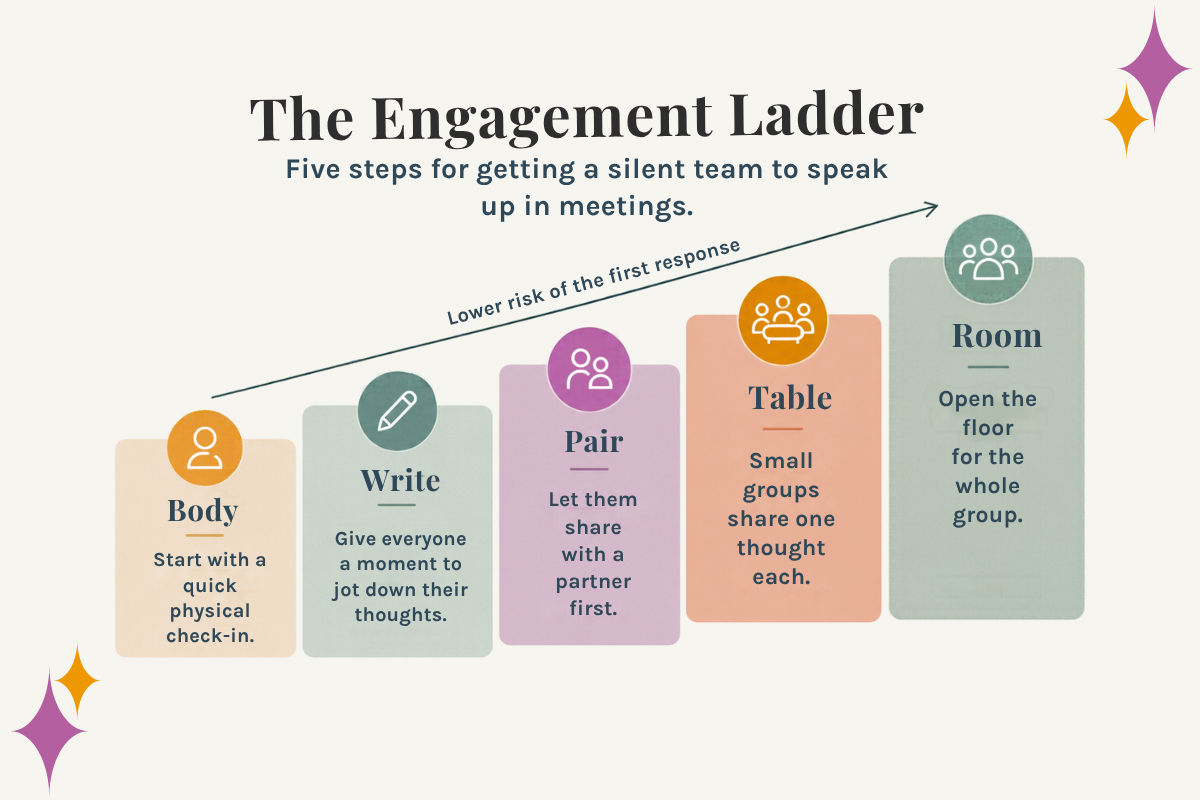
The engagement ladder is a five-step sequence for getting a group to talk by lowering the risk of the first response: body, write, pair, table, room. Each rung asks for less exposure than the one above it, every person answers several times in low-stakes forms before anyone speaks to the whole room, and you can stop at any rung.
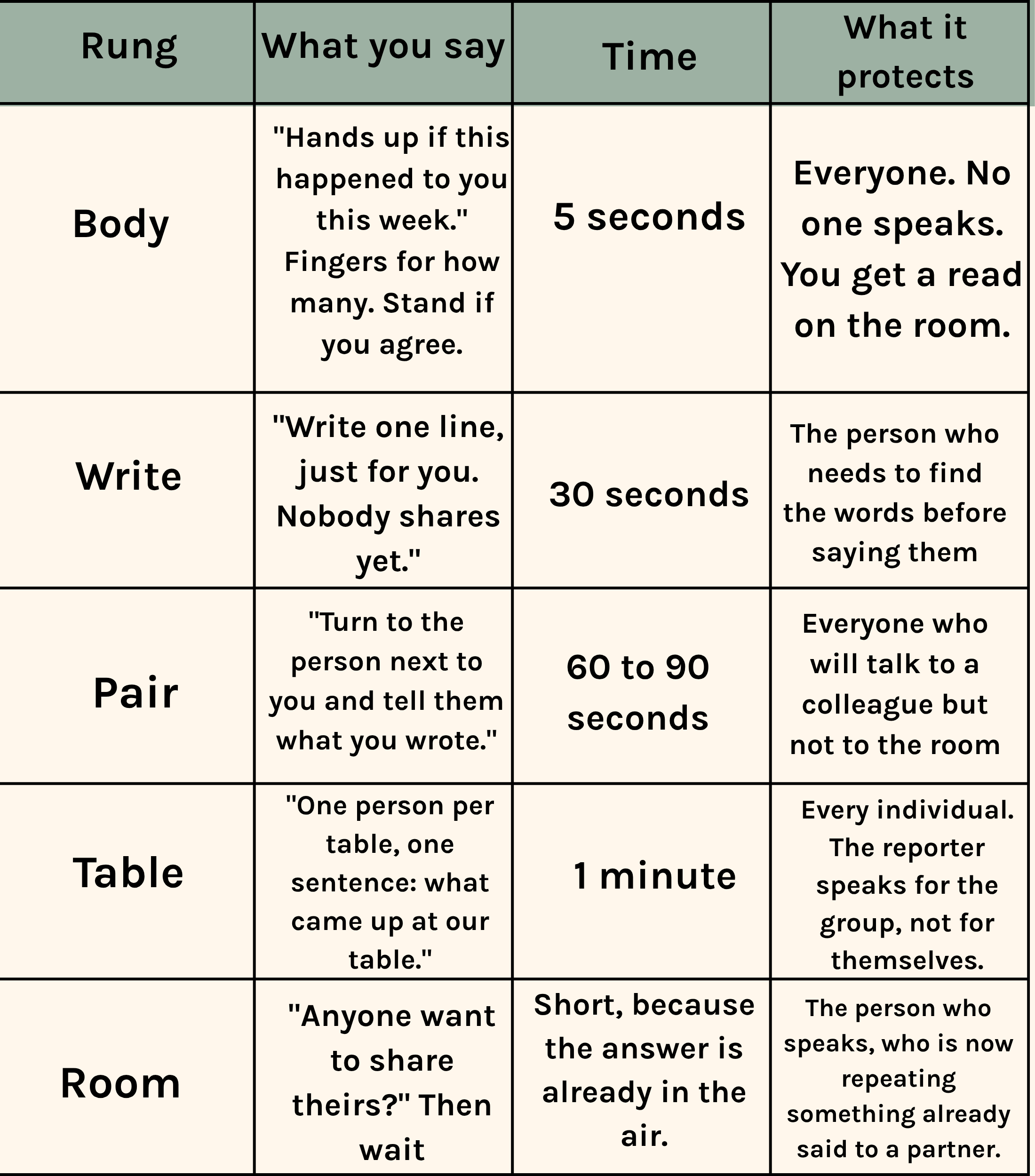
The ladder has a long lineage. Frank Lyman published think-pair-share in 1981, and the pattern of thinking privately before speaking publicly has been confirmed in classroom research ever since. Carello and Butler, writing on trauma-informed teaching in 2015, put the principle underneath it plainly: giving people choice about where and how much they share is a design decision, built into the structure, rather than a courtesy offered in the moment. The ladder is that principle turned into a sequence.
One rule runs alongside it: whenever you are the one talking for a stretch, the room does something every eight to ten minutes, even if it is thirty seconds of hands up. Nobody listens to anyone for twenty minutes straight.
How do you run the ladder in a staff meeting?
Pick one question, then climb. Ask it, have everyone write one line privately, turn to a neighbor and share, have one person per table report what came up at the table, then open the room and wait. By the time you ask the whole room, everyone has already answered three times.
Let’s practice with one question that pulls for vicarious resilience and gives the room something good to say: What's a client moment from the last few weeks that you keep coming back to because it was good?
Before the meeting. Put paper and a pen at every seat, and bring extras. Put the question and a visible clock on a slide or a whiteboard. If the room has been sitting still for a while, start one rung lower than writing: hands up if you had a moment like this in the last month.
Ask it, then write. Read the question and, before anyone can answer, say: write one line, just for you, thirty seconds, nobody shares yet. Every person now has an answer on paper, which means they have said it once, privately. The thing that stops people from speaking is almost always having to find the words in the moment, and that part is done.
Pair. Turn to the person next to you and tell them what you wrote. Ninety seconds. You already know this works, because it is what the break room is. Pairs are where your team actually talks, and this step brings the break room into the meeting. With a specific prompt and a visible clock, people start talking immediately, because nobody in a pair is performing for the room.
Table. If your team sits in groups, ask one person per table to give one sentence, and the sentence is what came up at our table. Nobody reports their own moment. They report the group's. Every individual stays protected and the room still hears what it needs to hear.
Room. Anyone want to share theirs? By now everyone has answered two to three times in lower-stakes forms, the content is in the air, and whoever speaks is offering something they have already said to a partner. This is where you wait. The silence here is short, because you earned the answer before you asked for it.
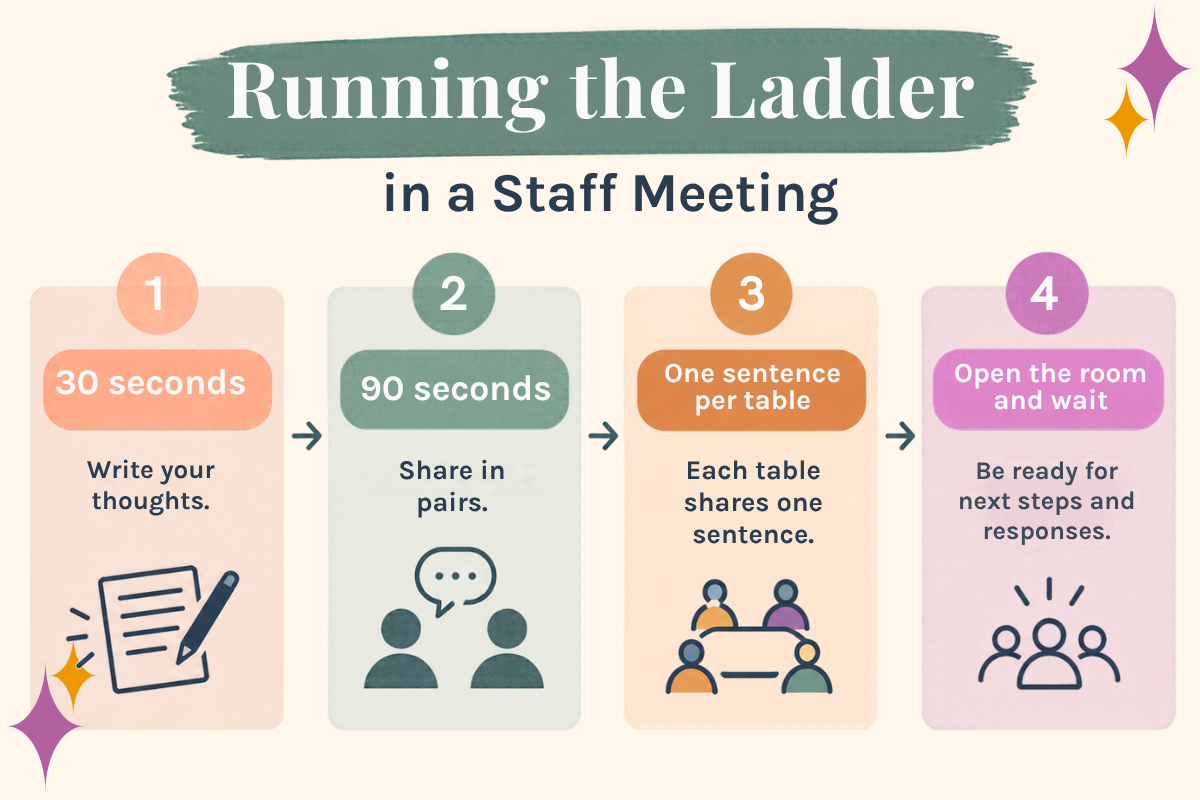
You can stop at any rung. Some questions never need to go past writing or pairs, and deciding that in advance is a design choice. The whole sequence fits inside a staff meeting or a group supervision hour without changing anything else about the meeting, and once your team has done it twice, "write, then pair" takes ten seconds to set up.
What should a leader do before asking the team to share?
Go first, at the level you're asking for. If the question is about a client moment, the leader gives hers, with the detail she hopes to get back. And every time you ask for a hand or a volunteer, say out loud that keeping your hand down is always fine. The first move shows the room what's allowed and the second shows the ladder isn't a trap.
A 2006 study by Nembhard and Edmondson looked at this in hospital teams, where the hierarchy is about as steep as it gets. The thing that changed whether people spoke up was what they named leader inclusiveness, or the words and actions of a leader that invite and value other people's contributions. It mattered most for the people at the bottom of the hierarchy, the ones who felt least safe. This means your team is watching what you do before they decide what is allowed in your room, and the most direct thing you can do is share first, with the amount of detail you are hoping they will match.
And then, every time you ask for a hand, a volunteer, or a share, say that keeping your hand down is always fine, and mean it. This tells the room that the ladder is an invitation rather than a trap, and the only way it works is if nobody is ever singled out for staying on a lower rung.
If you want the leader's version of this for debriefs specifically, I covered it in this episode on running debriefings and the leader's role.
What do you do with the silence after the question?
Stay in it. The skill leaders ask about most is holding a room after a hard question, and it comes down to not rescuing or punishing the silence, but staying present until the room finds out that saying the difficult thing out loud didn't end badly. That is the whole job in the first few minutes; everything after is technique.
Before an organization goes through The BRAVE Method training with me, the question leaders ask most is some version of "how do you hold a room?" What they are asking for is a skill, and it is a learnable one.
You ask the question
You keep your face open and your body still
You do not fill the pause, you do not call on anyone, and you do not let the silence turn into a judgment on the people in it
You stay there, visibly fine, until the first person finds out that saying the hard thing out loud did not end badly
After that, the room does most of the work.
Holding a room also means holding the right to decline. Sometimes a question lands and someone says something the room is not ready to carry, or you realize you are not ready to respond to it in front of everyone. You are allowed to say “That deserves more than we can give it here. I want to come back to it with you after this.” Said plainly and followed through, that sentence does two things at once: it models that a leader can set a limit without punishing the person who spoke, and it shows the team that they can set limits too.
The thing you must never do is let what was said disappear. If you name it and return to it, the room learns that speaking up is safe even when the answer is "not here."
How does this change clinical supervision?
Once a room can talk, the questions can change. Supervision asks what went wrong and what needs fixing, as it should. Adding a second kind of question, where a case has reached each person and what surviving it has built in the team, lets a team work its hardest cases together instead of carrying them alone.
The discussion I had to cut off in that training was a case discussion. The case was the hardest one the organization was supporting at the time: a client whose impact had left secondary traumatic stress and real wounds across the staff. Most teams cannot go near a case like that together. It turns into trauma dumping or it turns into blame, and so everyone learns to carry it alone. That day it became the most complete discussion of the case the team had ever had, and it stayed productive, because the questions were different. Where has this case reached each of you? What has surviving it built in this team?
Those questions come from the Reframe It part of The BRAVE Method, which looks at a case through vicarious resilience rather than only through what is going wrong. They do not replace the fixing questions. They sit next to them. The team told me afterward that building this into their supervision let them keep addressing problems while doing it from a strengths-based place again, and that the difference showed in how their staff came to the work.
Why doesn't one good meeting last?
Because everything in this field normalizes running on empty, and one good hour doesn't undo years of that. The next meeting slides halfway back, which is normal rather than a sign the method failed. What keeps a room open is a leader who builds the same door in the same place every time, so decide where this lives before you try it.
You will run the ladder, your team will talk, and the following week the room will be halfway back to where it started. It is tempting to read that as the whole thing failing. It is closer to the opposite. In 2010, Blume, Ford, Baldwin, and Huang pooled 89 studies on whether training carries over into actual work, and a supportive work environment was among the strongest predictors of whether anything stuck. For your team, the environment is you, the leader is the transfer lever.
So decide where this lives before the first attempt. Which meeting, which supervision hour, the first five minutes of which standing conversation. If it has a home, it repeats. If it does not, it becomes a story about that one good meeting you had once. The leaders who get the most from this are the ones who walk in already knowing which structure it belongs to, because they are the same leaders who have done the math on what a clinician leaving costs (the number is higher than most people think), and who have decided the meeting where people can speak is cheaper than the one where they cannot.
If you want a facilitator to run the whole arc with your team, leaders and clinicians in the same room, that is The BRAVE Method: the ladder, the questions, the skill of holding a room, and the supervision shift, delivered as a team training rather than something you have to build alone.
Frequently asked questions
How do I get my team to open up in meetings if they never have before?
Start lower on the ladder than feels necessary, and stay there longer than feels necessary. A team that has never spoken up in front of you needs several meetings of body, write, and pair before the room rung is a reasonable ask. Go first every time, and keep the hand-down sentence in every ask. The first time someone speaks to the whole room, how you respond in the next ten seconds decides whether there is a second time.
What if nobody speaks even after the pairs step?
Then you got what you needed from the pairs, and the room rung was too high a jump for this question in this group. Thank the pairs, note that the conversation happened, and move on. Nothing failed. Next time, add the table rung between pair and room, or make the room ask lighter: anything from your pair worth the whole room hearing? is easier to answer than "share yours."
Does the engagement ladder work on Zoom?
Yes, with different rungs. Reactions and polls replace hands. Writing becomes a chat waterfall: everyone types their line, nobody sends, then all send on your cue so no one is first. Breakout pairs replace turning to a neighbor. Unmuting to the whole call is the room rung, and it is a bigger jump online than in person, so stop at breakouts more often.
How do I run this if my team is only four people?
Skip the table rung. Body, write, pair, room works at any size, and with four people the room rung is close to a pair anyway. The write step matters more in a small team, not less, because there is nowhere to hide, and giving everyone thirty seconds on paper before anyone speaks is what keeps the most senior or most confident person from answering for everyone.
What if someone shares something I'm not ready to handle in front of the group?
You are allowed to say so. I want to give that the attention it deserves, and this isn't the place. Can we talk after? Then do it. Declining to respond in the room, done plainly and followed through, models two things your team needs to see: that a leader can set a limit without punishing the person who spoke, and that they can set limits too. What breaks trust is never the not here. It is letting what was said vanish.
Is it my fault that my team won't talk to me?
Almost never, and the research is clear on why. People bring rules about when speaking up is dangerous from every job they have ever had, and those rules switch on in the presence of any leader. The silence is aimed at the chair, not at you. What is yours is what happens next: the shape of the question, the wait, and whether you go first.
This week, take one question into one meeting. Write, pair, table, room, and then wait. The first silence is the room deciding whether you mean it, and when someone goes first, you get to watch your team find out they are allowed to say what this work gives them, in front of you.
If you lead a team that does this work, The BRAVE Method brings your leaders and clinicians into the room together to learn all of this at once. If you are a clinician reading this, The BRAVE Trauma Therapist Collective is where trauma therapists do this work together instead of alone.
And remember, vicarious trauma comes with being human in this work, and so does vicarious resilience. Being human is how we stay in the work we love.
References
Blume, B. D., Ford, J. K., Baldwin, T. T., & Huang, J. L. (2010). Transfer of training: A meta-analytic review. Journal of Management, 36(4), 1065-1105.
Brown, B. (2018). Dare to Lead: Brave Work. Tough Conversations. Whole Hearts. Random House.
Carello, J., & Butler, L. D. (2015). Practicing what we teach: Trauma-informed educational practice. Journal of Teaching in Social Work, 35(3), 262-278.
Cooper, K. M., Downing, V. R., & Brownell, S. E. (2018). The influence of active learning practices on student anxiety in large-enrollment college science classrooms. International Journal of STEM Education, 5, 23.
Detert, J. R., & Edmondson, A. C. (2011). Implicit voice theories: Taken-for-granted rules of self-censorship at work. Academy of Management Journal, 54(3), 461-488.
Edmondson, A. (1999). Psychological safety and learning behavior in work teams. Administrative Science Quarterly, 44(2), 350-383.
Lyman, F. (1981). The responsive classroom discussion: The inclusion of all students. In A. S. Anderson (Ed.), Mainstreaming Digest (pp. 109-113). University of Maryland College of Education.
Nembhard, I. M., & Edmondson, A. C. (2006). Making it safe: The effects of leader inclusiveness and professional status on psychological safety and improvement efforts in health care teams. Journal of Organizational Behavior, 27(7), 941-966.