Is It Vicarious Trauma or Burnout? What Leaders of Trauma-Exposed Teams Need to Know
Originally published September 2026.
Vicarious trauma is the lasting change in how a person sees the world that results from sustained empathic engagement with other people's trauma (McCann & Pearlman, 1990). It happens to therapists and to every staff member whose job involves that engagement. Burnout is a separate condition that can occur in any job. Vicarious trauma cannot be prevented, but its consequences can be, and the organization holds the levers.
Somewhere in your organization right now, a good clinician is deciding whether to stay. When they leave, the exit interview, if it happens, will say burnout, even if you had no idea they had gotten to that point. What you need to learn from this information though will help you be more intentional and get a greater ROI on your wellness budget.
I write this as a trauma psychologist, an assistant professor, and as the founder of BRAVE Providers LLC, where I train trauma-exposed teams and their leaders through The BRAVE Method so they can support their teams in the most effective and sustainable ways possible. I have also been the clinician who went quiet, years into full-time trauma work, when the world shifted for me in ways I could not have named until someone gave me the word for it.
This guide answers the questions leaders actually ask when they start looking into this, most of which the published literature answers only in fragments. It covers
What vicarious trauma is and who it happens to,
Why it can't be prevented and what can,
What protects staff (including a finding about treatment training that surprises most leaders),
How vicarious trauma differs from burnout in ways that change your strategic decisions,
Why struggling staff stay silent,
Whether telling staff about outcomes helps, and
What a leader can do at the next team meeting without changing a single budget line
What is vicarious trauma, and who does it happen to?
Vicarious trauma is a shift in a helper's beliefs about safety, trust, control, and the fairness of the world, produced by repeated empathic engagement with clients' traumatic material (McCann & Pearlman, 1990). It develops gradually over ordinary workdays and affects any role that involves sustained exposure to trauma, clinical or not.
The construct comes from Lisa McCann and Laurie Anne Pearlman's 1990 paper in the Journal of Traumatic Stress, where they described what happens to the inner world of a person who spends their working life engaging with other people's worst experiences. Their framework is built on cognitive schemas, or the working assumptions each of us carries about whether people are basically safe, whether the world is basically fair, whether we have control over what happens to us and the people we love.
Trauma work supplies evidence against those assumptions, one session at a time, and the assumptions bend to fit the evidence. The change is cumulative and normal and it happens the same way you get wet any time you walk through water.
The people this happens to in your organization are broader than your clinical staff. Anyone whose role requires connecting with people who have experienced trauma accumulates the same evidence for them.
Therapists carry the most concentrated dose, sure. But remember that intake coordinators hear the first telling of every story, often before the client has language for it. And case managers, advocates, and crisis line staff engage with trauma all day without a treatment frame to put it in. The person at your front desk absorbs the waiting room, environmental services staff clean the rooms where the work happens and hear more than anyone assumes. This means that when an organization designs its wellness supports for clinicians alone, it leaves most of its trauma-exposed workforce out of the picture.
Can vicarious trauma be prevented?
No. Vicarious trauma is an expected consequence of empathic engagement with trauma, and no training, stipend, or wellness program prevents it. What can be prevented, and addressed once present, are the conditions that develop when vicarious trauma goes unnamed and unsupported: compassion fatigue, secondary traumatic stress, and burnout.
Most organizational wellness spending is built on the premise that the right program or benefit will keep the work from affecting the people doing it. That premise is why so much of that spending disappoints. The EAP line, the self-care stipend, the lunch-and-learn on resilience all sit next to the work rather than within it, and they show up after the clinician has already decided the affected version of herself is a problem to hide.
Think of it this way. Vicarious trauma is the soil, and compassion fatigue, secondary traumatic stress, and burnout are the weeds that grow in it when nothing tends the ground. These are the outcomes your budget has actually been chasing and they respond to intervention, not benefits. The distinctions between these four experiences, and the order in which I see them develop for helping professionals, are laid out in the vicarious trauma versus compassion fatigue guide so start there to better understand the empathic distress continuum.
What protects staff from vicarious trauma?
Vicarious resilience is the positive change in a helper's beliefs, hope, and sense of meaning that results from witnessing clients recover and grow (Hernández, Gangsei, & Engstrom, 2007). It arrives through the same empathic engagement that produces vicarious trauma and supplies the opposite evidence. Staff who learn to notice it deliberately hold both.
The concept of vicarious resilience comes from Pilar Hernández, David Gangsei, and David Engstrom, who published it in Family Process in 2007 after interviewing twelve psychotherapists working with survivors of political violence and kidnapping in Colombia. They went looking for damage and found it, no surprise there. But they also found therapists who described being changed for the better by their clients. These therapists talked about having more hope about human beings' capacity to heal, greater perspective on their own difficulties, and a clearer sense of what they, the therapists, stood for. Engstrom, Hernández, and Gangsei extended the work in 2008 with clinicians in torture treatment settings, some of the most trauma-saturated clinical work that exists, and found the same pattern.
The mechanism through which vicarious resilience is experienced matters for a leader because it is the same mechanism as vicarious trauma. Each are experienced through the same channel, empathic engagement, and thus impact therapist schemas with opposite evidence about the world. A staff member who sees suffering all week and never sees recovery accumulates only vicarious trauma while a staff member who sees suffering and also sees people come through it accumulates both. The difference is rarely in the work itself. It is in whether anyone taught the staff member that vicarious resilience is real, that it provides this counterbalance to vicarious trauma, and that the organization understands and supports this.
Which is the reason I build organizational training around vicarious resilience instead of around burnout or self-care. Chasing burnout one person at a time is a contest the organization has already lost by the time it notices. Teaching a whole staff to notice and hold vicarious resilience is a skill that installs once and keeps working.
Does evidence-based treatment training protect clinicians?
Yes, in the research that exists. Clinicians who use evidence-based trauma treatments report higher compassion satisfaction and lower burnout and compassion fatigue than those who do not (Craig & Sprang, 2010), and teams that implement evidence-based practice with ongoing consultation retain more staff (Aarons et al., 2009). Vicarious trauma itself does not decrease, but the resulting compassion fatigue and burnout do.
So many people intuitively believe that trauma therapists and trauma specialists are damaged by their work. And it makes sense because the clinicians delivering the most intensive trauma treatments, cognitive processing therapy, prolonged exposure, written exposure therapy, EMDR, do sit closest to the traumatic material, so it seems they should need the most protection. The research on trauma clinicians says the opposite, and it has been accumulating for fifteen years.
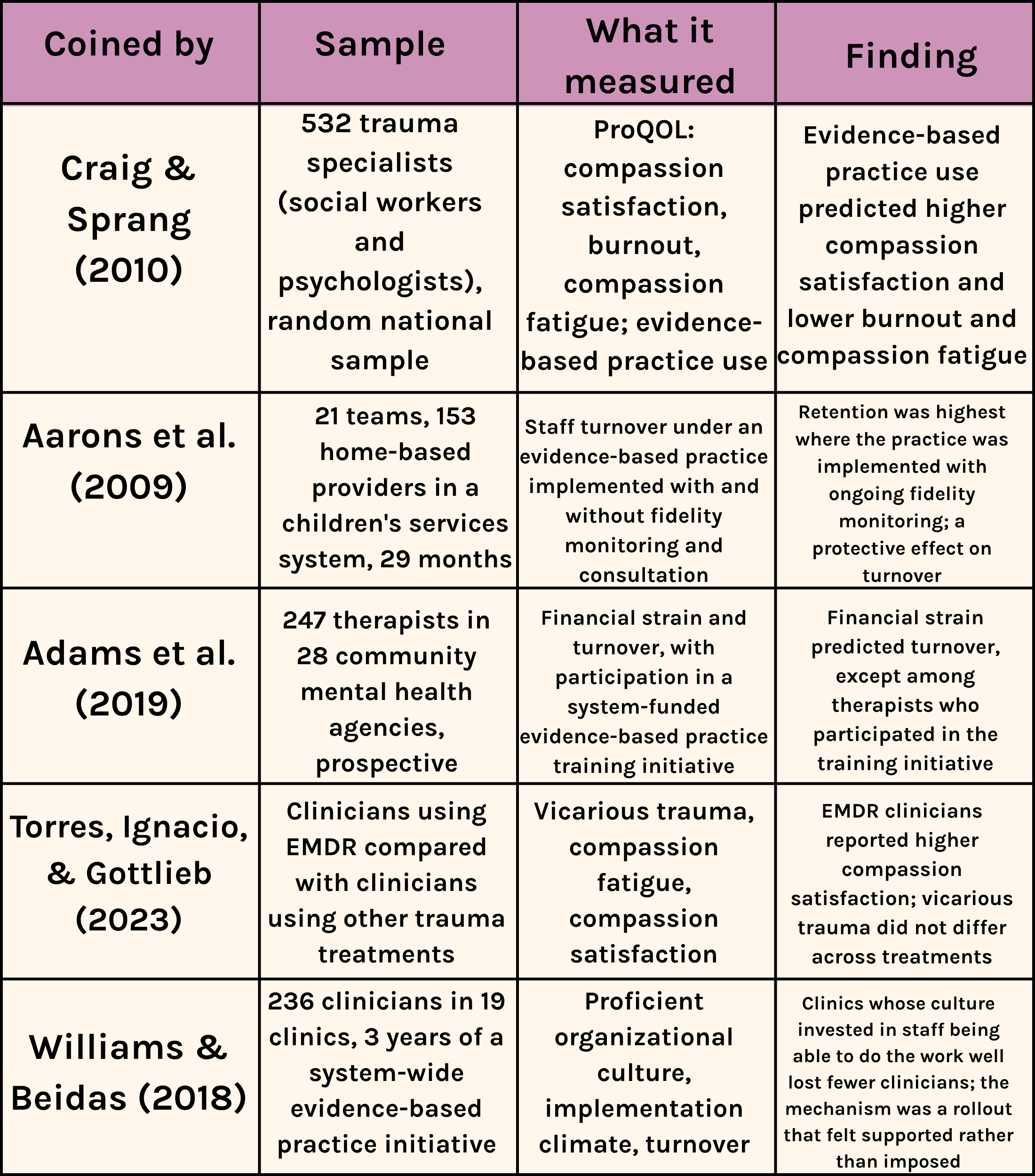
Read together, these studies say one thing: well-trained clinicians do not carry less vicarious trauma, they carry less of everything that grows on top of it, and more of what keeps them in the work.
Carlton Craig and Ginny Sprang's 2010 study is the foundation. Their sample was a random national draw of 532 licensed social workers and psychologists who identified as trauma specialists, measured with the ProQOL, the thirty-item Professional Quality of Life Scale that produces three scores: compassion satisfaction, burnout, and secondary traumatic stress. Clinicians who reported using evidence-based practices scored higher on compassion satisfaction and lower on burnout and compassion fatigue than clinicians who did not. Compassion satisfaction, the pleasure derived from doing the work well, is the closest thing the ProQOL has to a measure of vicarious resilience.
The organizational version came from Gregory Aarons and colleagues in 2009, in the Journal of Consulting and Clinical Psychology. Twenty-one teams of home-based providers in a statewide children's services system were followed for 29 months as an evidence-based practice was implemented. Therapist retention was highest in the condition where the practice came with ongoing fidelity monitoring and consultation. Aarons and colleagues described it as a protective effect on turnover, while describing an important nuance: the manual alone didn't keep people; the manual plus a structure that showed up every week to support the clinicians using it did.
Adams, Williams, Becker-Haimes, and colleagues found a related pattern in Philadelphia's public mental health system in 2019. Following 247 therapists across 28 agencies, they found that financial strain predicted whether a therapist left, with one exception. For therapists who participated in a system-funded evidence-based practice training initiative, financial strain stopped predicting turnover. The training did not change what those therapists were paid, but it did change whether pay was the deciding factor in the therapists staying in their job or not.
The EMDR literature supplies the piece that makes the pattern coherent. Torres, Ignacio, and Gottlieb, publishing in the Journal of EMDR Practice and Research in 2023, compared clinicians using EMDR with clinicians using other trauma treatments. EMDR clinicians reported higher compassion satisfaction. Their vicarious trauma was indistinguishable from everyone else's. What this tells us is that well-trained clinicians accumulate the same evidence that the world is cruel and they also accumulate counter-evidence, because effective treatment lets them watch people recover.
The take away here is that training your clinicians well is a vicarious resilience intervention, and it is worth funding as one. So if your organization considers treatment training as a clinical quality line item, the research says it is also a retention line item.
One caveat on all this. Woodard and colleagues, publishing in 2025 in the Journal of Behavioral Health Services and Research, found that implementing evidence-based practices in community mental health clinics did not change provider turnover. And Nate Williams and Rinad Beidas followed 236 clinicians across 19 Philadelphia clinics through a three-year system-wide rollout of evidence-based practice, and found that two organizational qualities decided who stayed. The first is what Charles Glisson's research calls a proficient culture, which describes an organization that takes responsibility for its staff being able to do the work well by making sure they have the skills their jobs require, giving them the support to be effective, and keeping client wellbeing at the center of its decisions. It is measured by what the organization does for its workers, not what it asks of them. The second is implementation climate, Mark Ehrhart and Gregory Aarons' term for whether a new practice feels carried in by the organization by being clearly prioritized, backed with training and ongoing help, and recognized when people use it.
Clinics with more proficient cultures kept more of their clinicians, and the reason was that those cultures produced strong implementation climates. So when we set the research by Woodard and colleagues beside that of Williams and Beidas, the two agree. Implementing a practice by itself keeps nobody. The organizations that invested in their people being good at the work also made the new practice feel supported rather than dumped on them, and those were the organizations clinicians stayed in.
How does a leader know the difference between vicarious trauma and burnout?
Burnout is emotional exhaustion, depersonalization, and reduced personal accomplishment produced by chronic occupational stress (Maslach & Jackson, 1981); it can occur in any job. Vicarious trauma is a change in worldview produced specifically by empathic engagement with trauma. Burnout responds to workload, control, and organizational climate. Vicarious trauma responds to sense-making, somewhere to put it, and support along the way.
Christina Maslach and Susan Jackson operationalized burnout in the early 1980s as three components:
Emotional exhaustion,
Depersonalization (a cynical, detached stance toward the people one serves), and
A diminished sense of personal accomplishment.
In plain language, burnout is what happens when a job takes more than it gives back. It happens to accountants and nurses and trauma therapists, you name it. And its strongest predictors in helping professions are isolation and organizational factors, which is the reason my own work concentrates on building community for clinicians and working with leaders rather than teaching self-care.
In comparison, vicarious trauma only happens through empathic engagement with other people's stress and trauma. That's what makes it unique to helping professionals (e.g. trauma therapists, doctors, educators). Through this exposure, it changes what a person believes about the world rather than how depleted they feel, although the two frequently coexist.
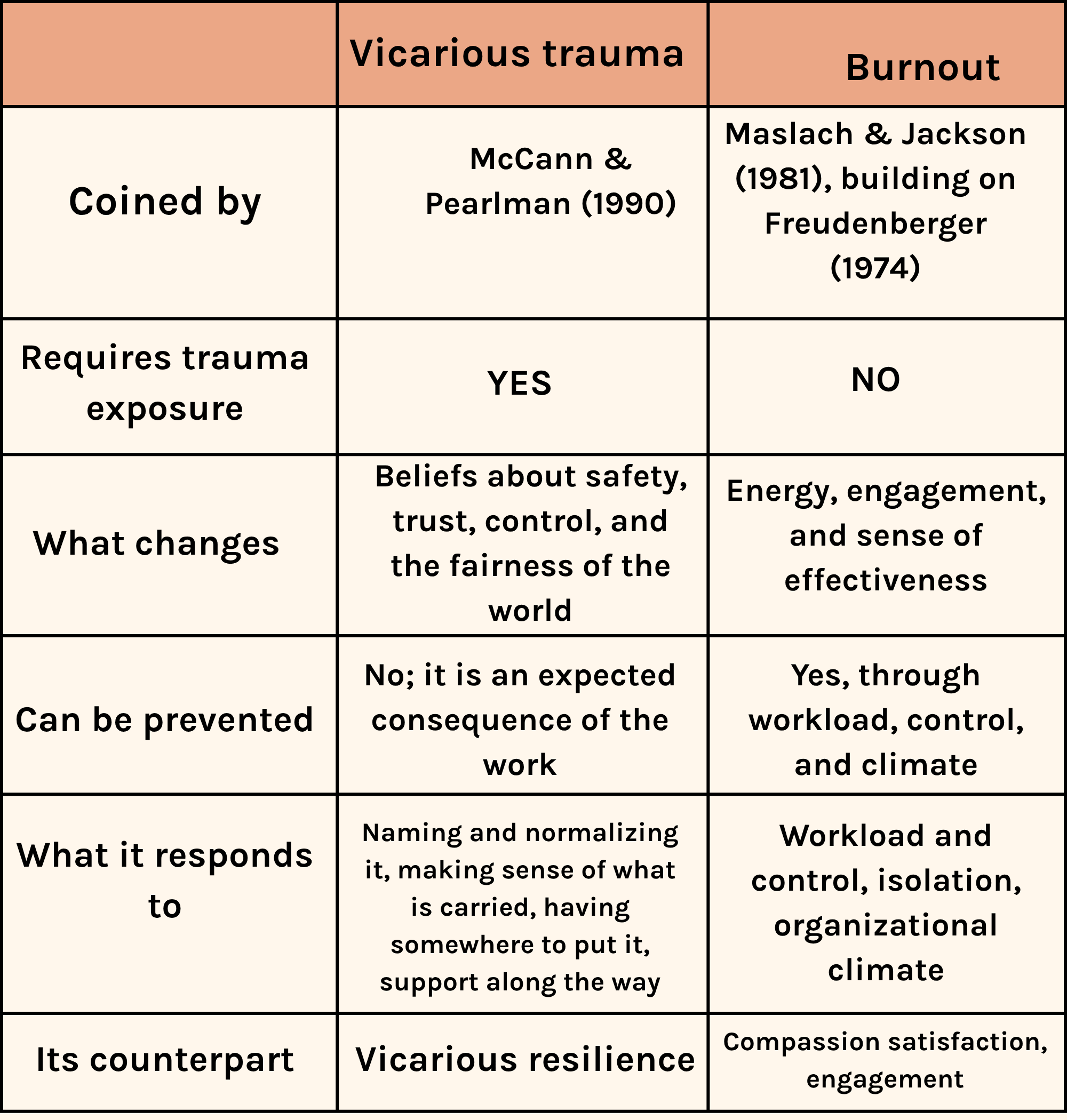
The single-sentence version: burnout is about what the job takes, vicarious trauma is about what the work changes, and a leader who treats the second as the first will keep buying the wrong things.
This means that there are two refinements that matter most for anyone in a leadership position, whether you're a supervisor, manager, CEO, or any other leadership role.
The first is that burnout is more nuanced than workload. I know many clinicians who carry full caseloads of trauma clients and love their jobs, because they work in organizations that are trauma-informed all the way through rather than only in the mission statement. The therapists in the original vicarious resilience research were focused entirely on working with survivors of political violence and torture and described the work as a source of hope. The caseload is rarely the decisive variable. The environment around the caseload is, which is what Williams and Beidas measured directly. And I hope this feels like an opening for you because I know how difficult it is to control caseload volume. That's decided by your contracts, waitlists, and funding streams. Leadership advice that begins with "reduce caseloads" is advice most leaders cannot act on. Which is ok because the organizational environment is the lever a leader actually holds.
The second is what vicarious trauma responds to. Making sense of what one is carrying and having somewhere to put it are the two conditions most leaders arrive at on their own. The third is support along the way, meaning another person or people present while the sense-making happens. None of this requires new billable hours, because all three can live inside supervision and team structures the organization already runs, if the organization chooses to structure things that way.
Why don't struggling staff say anything?
In organizations where vicarious trauma is not nameable, silence is what it looks like. Staff absorb the field-wide message that being affected by the work reads as a question about competence, so the most affected are often the most composed. Leaders who report that no one has complained are usually describing a culture, not a healthy team.
Something I hear all the time from leaders is that nobody on their team has complained so they don't need to do anything about vicarious trauma. While that's true for the leader, when I hear it, I don't necessarily feel reassured because your strongest people are usually the last to say anything. That's because clinicians and non-clinical staff learn early on that saying something makes their supervisor and colleagues question whether they're cut out for the work or not.
Normalizing vicarious trauma within your teams and organization helps to prevent the subtle and unspoken ways helping professionals start the quiet quitting process. I'm talking about your strongest clinician who starts to ask fewer questions in case consultation, the staff who have their camera off more often, and the dark humor that used to carry the team through hard weeks stops. As you start to pick up on these things, you first tell yourself the clinician is tired, because everyone is tired, but then their resignation letter lands. And while you aren't surprised, it hurts, because you would have moved things around for that person if they had said something. But they didn't, they probably didn't know they could, and no one can support what will not or cannot be said out loud.
Should leaders tell staff what happened to the people they helped?
It helps, and it is a story hour. Closing the loop on client outcomes gives staff counter-evidence, but it bypasses the empathic engagement that allows staff to also experience vicarious resilience. What changes an organization is teaching every staff member to identify, install, and enhance vicarious resilience in their own work, as a skill, inside structures that already exist.
Most organizations never close the loop for their non-clinical staff, or even throughout their teams. It often looks like this. The intake coordinator takes the first call, the case manager does the paperwork, the clinician delivers the treatment, and none of them ever hear that the client is back at work and sleeping through the night. Leaders who connect those dots for their teams are certainly onto something, and it's not a waste of time. But it also disempowers your non-clinical staff and robs them of the experience of vicarious resilience that is in front of them every day.
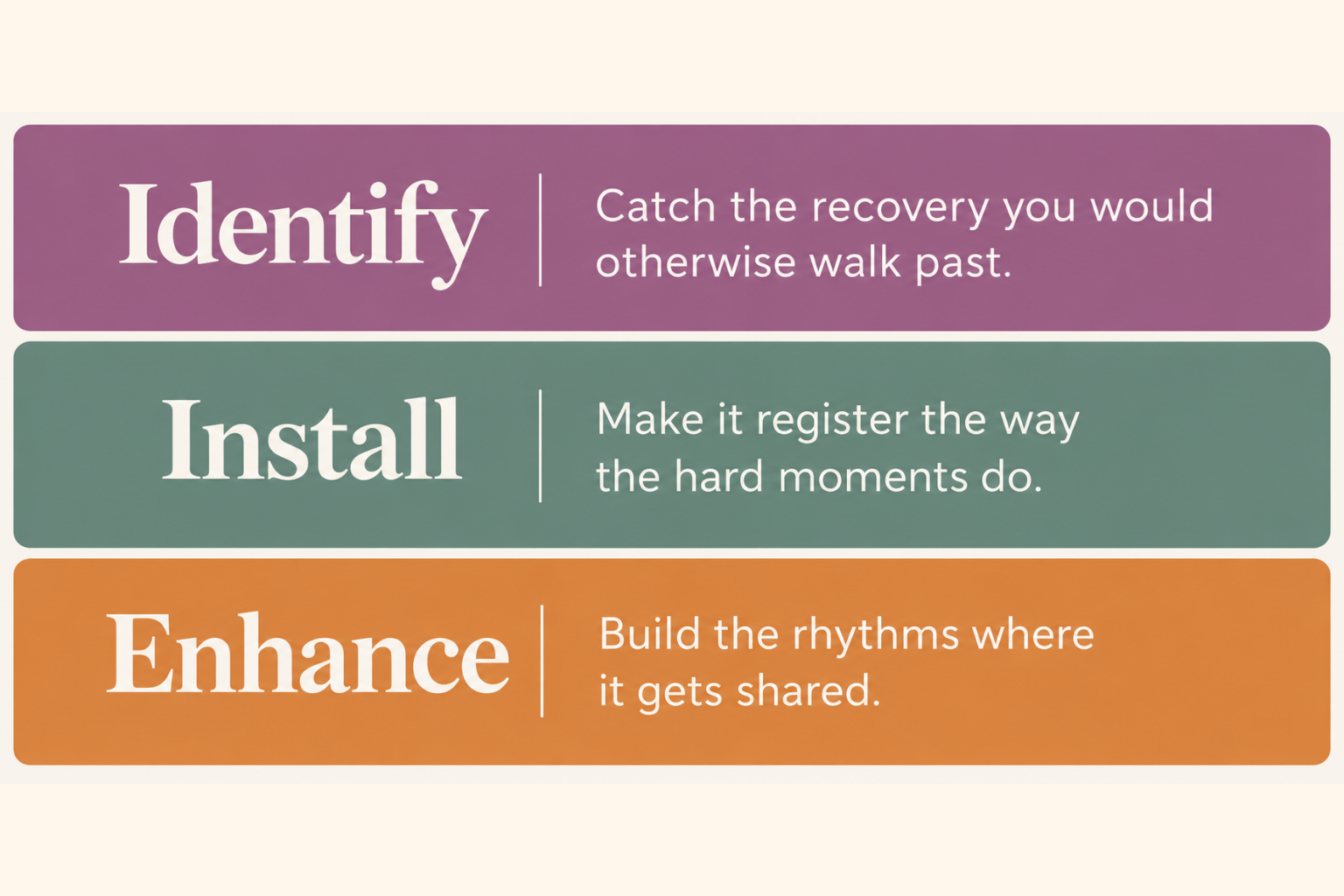
What I teach instead, after years of watching trauma-exposed teams, is an evidence-informed, three-part skill to train clinical and non-clinical staff how to notice vicarious resilience on purpose.
Identify
Learning to catch the moments of recovery and growth already happening and easily missed. Like the client who used to cancel every third session and has not cancelled in two months. Or the caller who says thank you and means it. How about getting to watch a client or family transform from their first time checking in at your clinic to now. When you think about it, every staff member has moments like these every week but since no one trained them about their importance, they go unnoticed.
Install
Making those moments register the way the hard ones register. Trauma work trains everyone in the building to track pain; no one is trained to hold onto the glimmers. So in a team meeting, instead of reviewing only the cases that are stuck, five minutes go to the one that shifted. In supervision, the supervisor asks what the clinician saw go right this week before asking what went wrong. It is small on purpose. At this scale it is sustainable, and it is the difference between a staff that goes home carrying only the weight and a staff that goes home carrying both.
Enhance
Building rhythms across the organization where individual experiences of vicarious resilience get shared so the counter-evidence one person collected becomes evidence for the whole team. This is where sharing outcome stories can make a difference, particularly if everyone is invited to share. I always recommend this be done inside the structures and schedules already present in your teams and organizations so it happens on a regular basis and doesn't rely on stories from just one person.
Integrating these Identify, Install, and Enhance practices into your existing systems means none of this requires additional time nor does it take away from clinical hours. Seamless integration allows this work to reach the whole staff instead of waiting for one struggling clinician to self-select into a short-term EAP.
If you lead a practice, agency, program, or team of trauma-exposed staff and you're ready to support your teams in a way that is actually sustainable, I invite you to learn more about The BRAVE Method. Every organization and group that goes through the training with me gets to learn together, staff and leadership, so that vicarious resilience gets built into how the organization actually operates. We collect data before and after using the ProQOL so you can truly see the outcomes and iterate using real data.
What can a leader do this week?

Normalize vicarious trauma from the top. When a leader names it as a normal part of the work, out loud, in front of the team, staff stop spending energy hiding what the work does to them, and the team gains access to vicarious resilience, which can't grow from an experience no one is allowed to admit is happening.
Normalization costs nothing and changes two things at once. The first is that staff stop spending energy on concealment. The second is that vicarious resilience becomes available, because no one can grow from an experience they are not allowed to acknowledge. Normalizing vicarious trauma is the door, and when you walk through it, vicarious resilience is what is on the other side of it.

And don't forget that the leader is part of the staff too. Leaders are trauma-exposed even after they stop doing direct clinical work. They hear the cases that escalate, sit in the debriefs after the worst days, and carry the ones that end badly with fewer people to tell, because the leader can't always take it to the team for support. Everything here applies far beyond clinicians and staff, to leaders too, and a team will trust this work in exact proportion to how real its leader is about it.
What to do Next:
Download the free Vicarious Trauma Tracker and complete it yourself before bringing it to anyone. It is the tool I built for exactly this conversation, and a leader who has done it can speak from experience rather than policy.
At the next regularly scheduled team meeting, name vicarious trauma as a normal part of the work, in your own words. The essentials are that the work is heavy, that being affected by it is expected and normal, that it has a name (vicarious trauma), that it happens to you too, and that you want to support the entire team and organization to name it without anyone wondering what it says about them.
Offer the Tracker as an optional exercise. Everyone receives a copy, everyone completes it privately, and sharing is a choice rather than an expectation (consent matters here the way it matters in a therapy room). Some people will share in the meeting, some will come find you a week later, and both mean it's working.
Notice how this doesn't require a budget request or additional hours in the week. And most importantly, it doesn't require someone to break first.
If you are the clinician reading this rather than the leader, send it to your director. And if what you need is a place where trauma therapists consult, learn, and are human together while the organization catches up, that is what The BRAVE Trauma Therapist Collective is for, and there is a free tier so cost is never the barrier.
Frequently asked questions
Is vicarious trauma the same as burnout?
No. Burnout is emotional exhaustion, depersonalization, and reduced personal accomplishment produced by chronic occupational stress, and it can happen in any job (Maslach & Jackson, 1981). Vicarious trauma is a change in a helper's beliefs about safety, trust, control, and the fairness of the world produced specifically by empathic engagement with trauma (McCann & Pearlman, 1990). The two often coexist but they respond to different interventions: burnout to workload, control, and climate; vicarious trauma to naming, sense-making, somewhere to put it, and support.
Can an organization prevent vicarious trauma in its staff?
No. Vicarious trauma is an expected outcome of sustained empathic engagement with trauma and occurs regardless of wellness programming. What an organization can prevent, and address when present, are the conditions that develop when vicarious trauma goes unnamed: compassion fatigue, secondary traumatic stress, and burnout. Organizations get further by normalizing vicarious trauma and teaching staff to identify vicarious resilience than by trying to keep the work from affecting the people who do it.
Does vicarious trauma only affect therapists?
No. It affects anyone whose role involves empathic engagement with trauma, including intake coordinators, case managers, advocates, crisis line staff, front desk staff, environmental services staff, etc. who work in trauma settings. Therapists carry the most concentrated exposure, but organizational supports designed only for clinicians leave most of a trauma-exposed workforce out. The same principle applies to vicarious resilience, which can be identified in any helping role once staff are taught what to look for.
Does training clinicians in evidence-based treatments increase their risk?
The research says the opposite. Craig and Sprang (2010) found that trauma therapists using evidence-based practices reported higher compassion satisfaction and lower burnout and compassion fatigue. Aarons et al. (2009) found higher retention on teams implementing an evidence-based practice with ongoing consultation. Torres, Ignacio, and Gottlieb (2023) found EMDR clinicians reported higher compassion satisfaction with no difference in vicarious trauma. Effective treatment lets clinicians witness recovery, which is the mechanism of vicarious resilience.
What is vicarious resilience?
Vicarious resilience is the positive change in a helper's beliefs, hope, and sense of meaning that results from witnessing clients recover from trauma and grow (Hernández, Gangsei, & Engstrom, 2007). It arrives through the same empathic engagement that produces vicarious trauma and supplies the opposite evidence about the world. It can be identified, installed, and enhanced deliberately, which is the basis of The BRAVE Method's organizational training.
What should a leader say to a team about vicarious trauma?
Name it as a normal part of the work, out loud, at a regularly scheduled meeting. The essentials: the work is heavy, being affected by it is expected, it has a name, it happens to the leader too, and the leader wants a team where it can be named without anyone wondering what it says about them. Follow with an optional, private exercise such as the Vicarious Trauma Tracker, with sharing as a choice. Consent and the leader's own participation are what make the conversation credible.
Why does my team never complain about vicarious trauma?
In organizations where vicarious trauma is not nameable, silence is what it looks like. Staff absorb the field-wide message that being affected by the work reads as a question about competence, so the most affected are often the most composed. A clinician will only say it out loud if she expects it to be received by the organization, not just by one sympathetic supervisor. Leaders who hear no complaints are usually describing a culture rather than a healthy team, and the resignation letter is often the first data point.
References
Aarons, G. A., Sommerfeld, D. H., Hecht, D. B., Silovsky, J. F., & Chaffin, M. J. (2009). The impact of evidence-based practice implementation and fidelity monitoring on staff turnover: Evidence for a protective effect. Journal of Consulting and Clinical Psychology, 77(2), 270–280. https://pubmed.ncbi.nlm.nih.gov/19309186/
Adams, D. R., Williams, N. J., Becker-Haimes, E. M., Skriner, L., Shaffer, L., DeWitt, K., Neimark, G., Jones, D. T., & Beidas, R. S. (2019). Therapist financial strain and turnover: Interactions with system-level implementation of evidence-based practices. Administration and Policy in Mental Health and Mental Health Services Research, 46(6), 713–723. https://pmc.ncbi.nlm.nih.gov/articles/PMC7083521/
Craig, C. D., & Sprang, G. (2010). Compassion satisfaction, compassion fatigue, and burnout in a national sample of trauma treatment therapists. Anxiety, Stress, & Coping, 23(3), 319–339. https://www.tandfonline.com/doi/full/10.1080/10615800903085818
Engstrom, D., Hernández, P., & Gangsei, D. (2008). Vicarious resilience: A qualitative investigation into its description. Traumatology, 14(3), 13–21. https://journals.sagepub.com/doi/10.1177/1534765608319323
Hernández, P., Gangsei, D., & Engstrom, D. (2007). Vicarious resilience: A new concept in work with those who survive trauma. Family Process, 46(2), 229–241. https://onlinelibrary.wiley.com/doi/abs/10.1111/j.1545-5300.2007.00206.x
Maslach, C., & Jackson, S. E. (1981). The measurement of experienced burnout. Journal of Occupational Behaviour, 2(2), 99–113. https://onlinelibrary.wiley.com/doi/10.1002/job.4030020205
McCann, I. L., & Pearlman, L. A. (1990). Vicarious traumatization: A framework for understanding the psychological effects of working with victims. Journal of Traumatic Stress, 3(1), 131–149. https://link.springer.com/article/10.1007/BF00975140
Torres, J., Ignacio, J., & Gottlieb, D. (2023). Reducing the cost of caring: Indirect trauma exposure on mental health providers. Journal of EMDR Practice and Research. https://spj.science.org/doi/10.1891/EMDR-2022-0044
Williams, N. J., & Beidas, R. S. (2018). Navigating the storm: How proficient organizational culture promotes clinician retention in the shift to evidence-based practice. PLOS ONE, 13(12), e0209745. https://pmc.ncbi.nlm.nih.gov/articles/PMC6303097/
Woodard, G. S., Michael, O., Douglas, S., Cavanaugh, P., & Jensen-Doss, A. (2025). Evidence-based practice implementation does not affect provider turnover in community mental health clinics. The Journal of Behavioral Health Services & Research. https://link.springer.com/article/10.1007/s11414-025-09955-1