Vicarious Trauma vs. Compassion Fatigue (and Burnout and Secondary Traumatic Stress): What's the Difference?
By Jenny Hughes, PhD | Originally published March 2026. Last updated July 2026.
Vicarious trauma changes a therapist's beliefs about the world through empathic engagement with clients' trauma (McCann & Pearlman, 1990). Compassion fatigue drains the capacity to care (Figley, 1995). Secondary traumatic stress produces PTSD-like symptoms (Figley, 1995). Burnout is exhaustion from chronic workplace stress in any job (Maslach & Jackson, 1981). Burnout and secondary traumatic stress can happen to anyone; vicarious trauma and compassion fatigue are unique to helping professionals.
If you're a trauma therapist trying to figure out which of these you're carrying, you're asking exactly the right question, and you're asking it inside a field that has made the answer harder than it needs to be. These four terms get used interchangeably in trainings, articles, and casual conversation, which means most therapists reach for whichever word is closest, usually "burnout," even when something else is happening underneath it.
The distinction isn't academic. The kind of help that actually works depends on what's actually going on. If you mistake exposure impact for a workload problem, you can keep trying to rest your way out of something that needs processing, reflection, and support. If you call everything vicarious trauma, you can miss the very real structural conditions grinding you down.
I'm a trauma psychologist. I've spent my career treating PTSD, training therapists, and building a community where trauma therapists carry this work together, and I've been on the wrong side of every construct on this page at least once. This guide walks through each pair of distinctions the research draws, puts all four side by side in one table, shows you how I map their relationship clinically, and gives you a practical way to tell which one is loudest for you right now.
What's the difference between vicarious trauma and compassion fatigue?
Vicarious trauma is the inner transformation of a helper's beliefs about safety, trust, and the world through empathic engagement with clients' trauma (McCann & Pearlman, 1990). Compassion fatigue is the erosion of the capacity and desire to bear others' suffering (Figley, 1995). One changes what you believe; the other drains what you have to give.
These two get conflated more than any other pair, partly because they often show up in the same therapist in the same season. The research draws them differently.
Vicarious trauma, named by trauma researchers Lisa McCann and Laurie Anne Pearlman in 1990, describes what repeated empathic engagement with trauma material does to the person doing the engaging. It works on your cognitive schemas: your baseline assumptions about safety, trust, control, and other people. The therapist experiencing vicarious trauma isn't primarily tired. She's changed. The world reads as more dangerous than it used to, and she may not have noticed the shift happening.
Compassion fatigue comes from a different lineage. The term was first used by Joinson (1992) describing nurses, and Charles Figley (1995) developed it for the helping professions broadly, describing it as the cost of caring: a deep erosion of the emotional resources you use to empathize. The therapist experiencing compassion fatigue still knows how to care, but the caring has started running on an empty tank. Sessions that used to engage her now feel like lifting something heavy. Her cup has nothing left in it, at work or at home.
You can feel the difference from the inside if you know what to ask. Vicarious trauma tends to follow you into your worldview: you scan for danger at the playground, you trust more slowly, your mind jumps to what could go wrong. Compassion fatigue tends to show up in your capacity: empathy costs more effort than it used to, and the part of you that used to refill overnight doesn't. I've written a fuller piece on understanding compassion fatigue if that's the thread you want to pull first.
Is it actually burnout? Vicarious trauma vs. burnout
Burnout is a syndrome of exhaustion, cynicism, and reduced sense of accomplishment resulting from chronic workplace stress (Maslach & Jackson, 1981; World Health Organization, 2019). Unlike vicarious trauma, it requires no trauma exposure at all. Burnout comes from the structure around the work; vicarious trauma comes from the content of it.
There are times when burnout is exactly the right word. The work has become too full, the pace too relentless, the recovery too thin, and your whole system starts protesting in ways that make perfect sense. Burnout is the oldest and best-measured construct on this page. Freudenberger (1974) named it, and Maslach and Jackson (1981) gave it the three-dimensional shape research still uses: emotional exhaustion, depersonalization (that creeping cynicism toward the people you serve), and a reduced sense of personal accomplishment. The World Health Organization now classifies it in the ICD-11 as an occupational phenomenon resulting from chronic workplace stress that has not been successfully managed, notably not as a medical condition.
Burnout can happen to an accountant. It comes from the structure of the work itself. Too many clients, too much admin, too little control, not enough support, recovery that never quite happens because there's always one more note hanging over you. Over time your tank runs low because the structure keeps asking for more than it gives back.
Vicarious trauma is different. It comes from what happens when your nervous system and your worldview are shaped by repeated empathic engagement with trauma. We hear what happened. We take it in. We hold it with care. And even when we know it isn't our trauma, our bodies do not relate to those stories in some neat, detached way. The work lands.
The two overlap easily, and a therapist can be structurally depleted and saturated by exposure at the same time. Even then, it helps to ask which one is loudest right now, because the interventions point in different directions. If the structure is the problem, no amount of processing your caseload's content will fix your caseload's size. I've written about building a trauma therapy career that lasts for the structural side of that conversation.
Where does secondary traumatic stress fit?
Secondary traumatic stress is the presence of PTSD-like symptoms, such as intrusive images, avoidance, and heightened arousal, acquired through exposure to others' trauma rather than your own (Figley, 1995). Like burnout, and unlike vicarious trauma, it can happen to anyone: DSM-5 recognizes secondary exposure as qualifying trauma exposure (American Psychiatric Association, 2013).
Secondary traumatic stress (STS) is the construct that most resembles what your clients experience. Figley (1995) described it as the natural consequent behaviors and emotions resulting from knowing about a trauma experienced by another and wanting to help. When it happens in a helping role, it looks like nightmares about your clients' stories, intrusive images from sessions you didn't attend as a participant but somehow carry as if you did, and a body that startles as though the danger were yours.
STS is also the one construct on this page, besides burnout, that can happen to anyone. A parent who learns the details of their child's assault, a partner absorbing a survivor's story over years, a juror sitting with weeks of aversive evidence: none of them is a helping professional, and all of them can develop secondary traumatic stress. The DSM-5 makes this concrete. Its PTSD Criterion A includes learning that a traumatic event happened to a close family member or friend, and repeated or extreme exposure to aversive details of traumatic events (American Psychiatric Association, 2013). STS isn't a diagnosis by name, and it doesn't need to be: secondary exposure is qualifying trauma exposure, which means an STS presentation can meet full criteria for PTSD. One boundary worth knowing, since the internet version of this claim overreaches: the repeated-exposure route excludes media exposure unless it's work-related. Doomscrolling is corrosive, but it isn't Criterion A.
The distinction from vicarious trauma is the distinction between symptoms and schemas. STS gives you the symptom picture: intrusions, avoidance, arousal. Vicarious trauma gives you the belief picture: a world that reads as less safe, people who read as less trustworthy. A therapist can have either without the other, and plenty of us have had both.
The field itself blurs these lines. Researchers have used compassion fatigue, secondary traumatic stress, and vicarious traumatization interchangeably in titles and measured them with overlapping instruments, and a systematic review by Rauvola, Vega, and Lavigne (2019) documents just how tangled the construct space is. So much of the advice out there contradicts itself because the terms underneath it do. The definitions above are the distinctions the primary sources drew; the mess is what happened after.
All four side by side
The table below holds the constructs in the order they unfold in my clinical model (more on that in the next section).
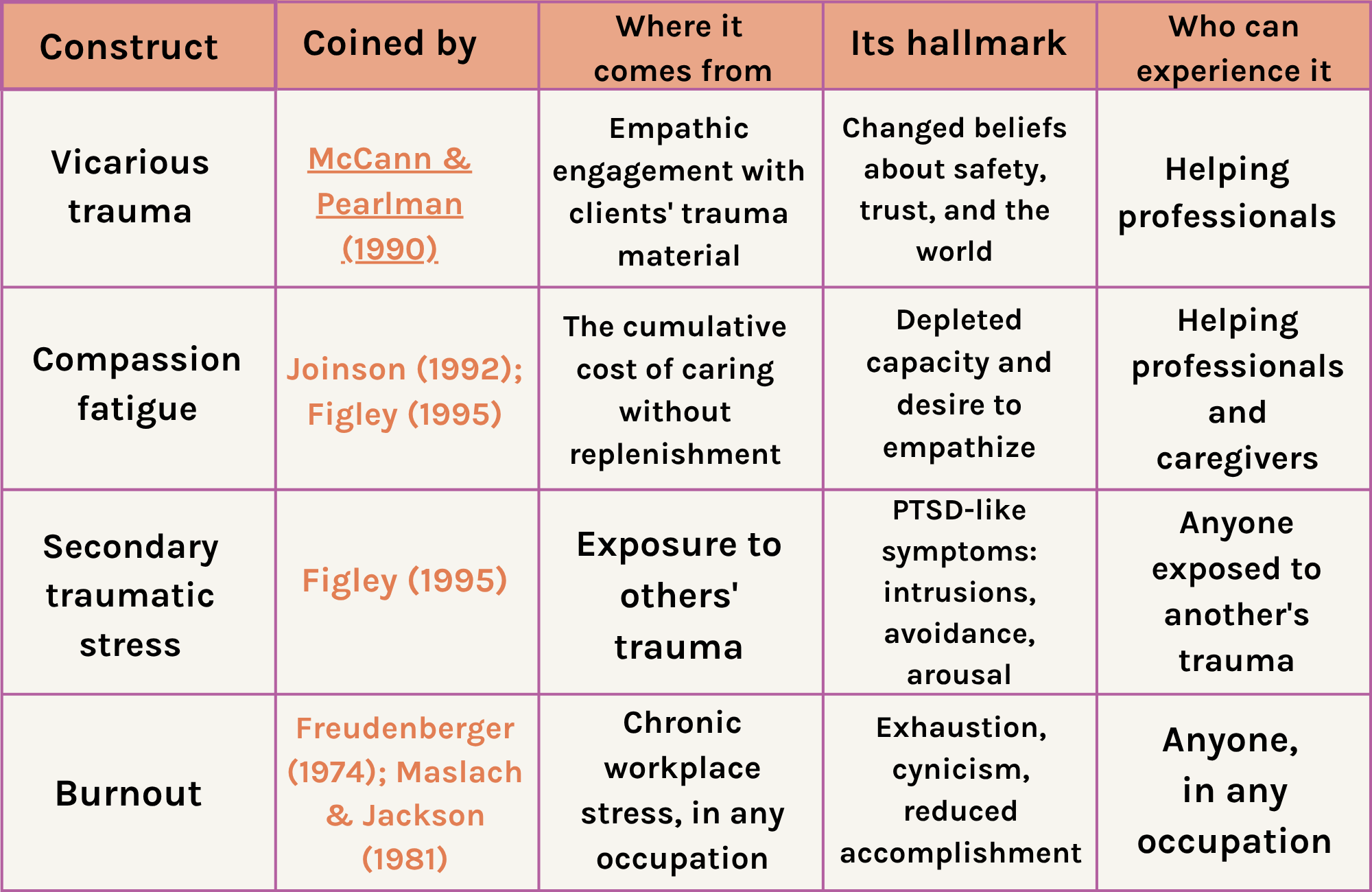
The shortest version: vicarious trauma changes what you believe, compassion fatigue drains what you have to give, secondary traumatic stress gives you symptoms, and burnout runs the tank dry. The accountant can get the last two. Only the people doing the caring can get the first two.
How the four fit together: the Trauma Therapist Trauma Response
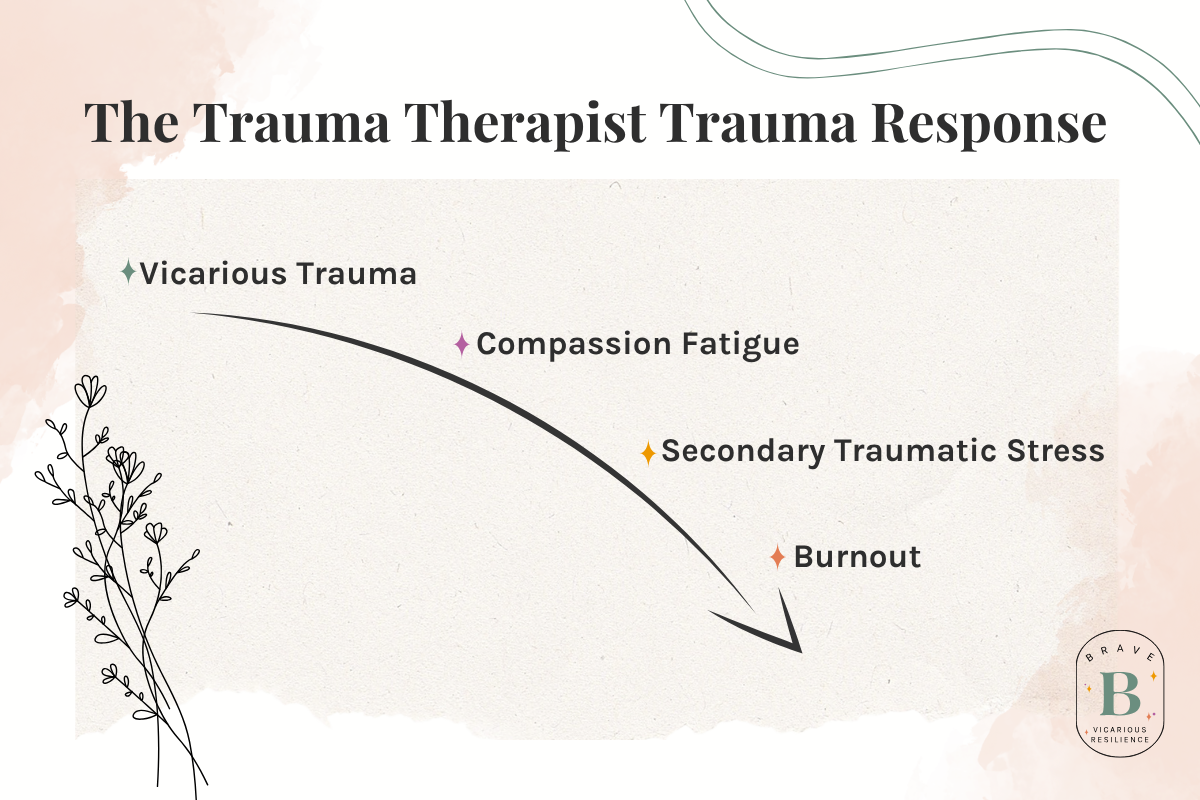
The Trauma Therapist Trauma Response is my clinical model of how these constructs unfold in trauma therapists: vicarious trauma, when unsupported, progresses toward compassion fatigue, secondary traumatic stress, and burnout, with research showing genuine complexity in how the last two relate.
The literature gives you four definitions. It doesn't give you a map of how they move through an actual therapist's career, so after years of clinical work, my own run-ins, and watching hundreds of therapists inside The BRAVE Trauma Therapist Collective, I built one.
In the Trauma Therapist Trauma Response, vicarious trauma is the front door. It's the expected, near-universal impact of doing empathic trauma work. When vicarious trauma goes unnamed and unsupported, it can progress: toward compassion fatigue as the caring capacity erodes, toward secondary traumatic stress as the nervous system starts producing symptoms, and toward burnout as the whole system runs out of road.
Two caveats. First, the relationship between secondary traumatic stress and burnout is genuinely complicated in the research. Shoji and colleagues (2015) followed helping professionals in two longitudinal studies, in the U.S. and Poland, and found that job burnout predicted later secondary traumatic stress more than the reverse, which complicates any tidy one-directional arrow. Rauvola et al. (2019) reached a similar conclusion about the construct space as a whole. My model holds that complexity with a bidirectional relationship rather than pretending the field has settled it. Second, nothing in psychology or the human experience is linear, and no therapist moves through these in lockstep.
The model also encodes the boundary that runs through this whole guide: vicarious trauma and compassion fatigue are unique to helping professionals, because both require the sustained empathic caring that is the substance of our work. Secondary traumatic stress and burnout have no such requirement. That's why a trauma therapist can be carrying all four at once while her neighbor the accountant can only ever carry two.
The full model, including the four domains where vicarious trauma shows up, lives in my complete guide to vicarious trauma.
How do you tell which one you have?
Start with two questions: would your symptoms drop if the client content got lighter but the workload stayed the same (points to vicarious trauma), or if the workload eased but the content stayed the same (points to burnout)? "Both" is a common and legitimate answer.
When therapists ask me how to tell the difference, I usually come back to two questions.
First: if your workload stayed the same, but your client content got lighter for two weeks, would your symptoms drop noticeably? If yes, that points toward vicarious trauma. The exposure itself is playing a big role in what your system is carrying.
Second: if your client content stayed the same, but your workload eased up and your recovery actually improved, would your symptoms drop noticeably? If yes, burnout is probably the louder driver. The structure around the work is what's draining you.
Sometimes people answer no to both, and that's not unusual. Usually it means the answer is both, or that compassion fatigue has entered the picture and the depletion has stopped responding to small adjustments in either direction.
A few signs that point more toward the exposure side than the structural side: you replay sessions at night, and it feels less like overthinking and more like something in you hasn't fully put the session down. You're hypervigilant about client safety, running crisis plans in your head while you're supposed to be making dinner. You're more reactive outside of work, sharper and more protective than you want to be. Your worldview feels heavier, with your mind jumping to what could go wrong. And, the one that's easiest to miss because it feels contradictory: your cynicism has increased but your compassion is still there. Burnout tends to take the caring with it; vicarious trauma often leaves the caring intact and makes it cost more.
If you want this done properly rather than by feel, I built a free three-minute quiz for exactly this question. It walks you through the differentiators and tells you which experience is loudest for you right now: take the vicarious trauma vs. compassion fatigue vs. burnout quiz.
You might also live with anxiety, or depression, or your own PTSD. None of that disqualifies you from being a trauma therapist, and it doesn't make your experience of any of these occupational impacts less valid. What it adds is nuance, and nuance gives you options. When you can start to notice "this is my anxiety" and "this might be vicarious trauma" as different threads, you can stop internalizing all of it as personal failure and start responding in ways that fit what's actually happening.
Does the label matter? What helps for each
Yes, because the interventions differ. Burnout requires changing the structure around the work. Vicarious trauma requires giving the exposure somewhere to go: language, witnessing, and reflection. Compassion fatigue requires replenishment before output. Most therapists need some combination, matched to what's loudest.
Once you have a better sense of what's driving things, the next step usually becomes less confusing.
If burnout is primary, the intervention has to include the structure around the work. That may mean reducing demand, getting more honest about what your caseload is costing you, protecting recovery time, changing your boundaries, or naming the ways support is missing. Burnout does not resolve because you suddenly become better at coping with impossible conditions.
If you lead a practice, agency, or program, this paragraph is your part of the guide. The conditions are the lever you control, and shifting them does more for your team than any wellness perk. That's the work I do with organizations through The BRAVE Method, training teams and leaders to address vicarious trauma and its downstream effects at the level where they actually start.
If vicarious trauma is primary, the intervention needs to address exposure. This is where therapists often get stuck, because we are so used to being the one who holds. But exposure impact needs somewhere to go. It needs language, witnessing, reflection, and spaces where the cost of the work can be spoken out loud instead of privately managed. This is the territory of my Name It, Tame It, Reframe It framework: Name It by tracking what the work is actually bringing up rather than gaslighting yourself one data point at a time; Tame It by coming back to what you already know helps your system, done more deliberately; Reframe It by widening the frame to include what trauma work also exposes you to, which is survival, courage, repair, and change. That last move is the doorway to vicarious resilience, and it deserves its own guide, so I wrote one.
If compassion fatigue is primary, replenishment has to come before output. That is not a bubble bath prescription. It means consultation where you're the one being resourced, protected contact with the parts of the work and your life that give something back, and permission to let your capacity be finite. The frustrating truth about compassion fatigue is that it responds slowly to everything except genuine restoration and genuinely reduced demand.
And if it's several at once, which it often is, the answer is not to pick one and ignore the rest. The answer is to stop treating yourself like the problem and start responding to what the work has actually asked of you. None of these experiences means you're not strong enough, not good enough, or not cut out for this work. They mean the work is reaching you, which was always going to happen, and they're worth responding to with the same care you'd bring to a client's presentation.
Everything above works better with structure and company. That's what The BRAVE Trauma Therapist Collective is for: consultation calls, guest expert trainings, and a community of trauma therapists who track this together and tell the truth about the work. There's a free tier, so cost doesn't have to be the barrier. And if you're a leader reading this for your whole team, The BRAVE Method brings the training to your organization. Come join us, and share with us what this work has been asking of you lately. We get it, and we'd rather carry it with you than watch you carry it alone.
Frequently asked questions
Is compassion fatigue the same as burnout?
No. Compassion fatigue is the depletion of your capacity to empathize, and it's specific to caring work (Figley, 1995). Burnout is exhaustion, cynicism, and reduced accomplishment from chronic workplace stress in any occupation (Maslach & Jackson, 1981). Compassion fatigue can be a station on the road to burnout for helping professionals, but plenty of burnout involves no caregiving at all, and compassion fatigue can exist in a therapist whose workload is otherwise sustainable.
Can you have vicarious trauma and burnout at the same time?
Yes, and many trauma therapists do. Vicarious trauma comes from the content of the work and burnout from the structure around it, and nothing prevents both from being active at once. The practical move isn't choosing which one is real; it's asking which is loudest right now, because that determines whether the first intervention should target your exposure or your conditions.
What's the difference between secondary traumatic stress and compassion fatigue?
Secondary traumatic stress is a symptom picture: PTSD-like intrusions, avoidance, and arousal acquired through exposure to others' trauma. Compassion fatigue is a capacity picture: the erosion of your ability and desire to keep caring. Figley's work connects them closely, and researchers have sometimes used the terms interchangeably (Rauvola et al., 2019), but a therapist can be symptomatic without being depleted, and depleted without being symptomatic.
Is any of these a diagnosis?
None of the four is a diagnosis by name. Burnout appears in the ICD-11 as an occupational phenomenon, explicitly not a medical condition (World Health Organization, 2019). Vicarious trauma and compassion fatigue are constructs from the research literature. Secondary traumatic stress sits closest to diagnostic territory: DSM-5 recognizes secondary exposure, learning of a close person's trauma or repeated exposure to aversive details, as qualifying Criterion A exposure, so an STS presentation can meet full criteria for PTSD (American Psychiatric Association, 2013). If your symptoms meet criteria for PTSD, depression, or an anxiety disorder, that's a conversation for your own therapist or physician, and having those diagnoses doesn't disqualify you from this work.
Do you have to be a trauma therapist to experience these?
No, and the four split cleanly in two. Burnout can happen in any job, and secondary traumatic stress can happen to anyone exposed to another person's trauma, including family members and partners of survivors (American Psychiatric Association, 2013). Vicarious trauma and compassion fatigue are unique to helping professionals and caregivers, because both arise from sustained empathic caring, which is the substance of the role. If you're a helper of any kind reading this page, all four apply to you, and the research and guidance here are written for you.
Where should I start if I think it's all four?
Start with what's loudest, and start smaller than you think. Take the three-minute quiz to sort the threads, pick the one sign that felt uncomfortably familiar, and track it for a week. Then bring what you find to another human: consultation, your own therapy, or a community of therapists who understand the work. The one thing not to do is metabolize this in isolation, because isolation is the condition under which all four constructs do their worst work.
About the Author

Jenny Hughes, PhD, is a licensed clinical psychologist and Assistant Professor at UTHealth Houston and LSU Health Sciences Center, where she treats adults with PTSD and trains trauma therapists. She is the author of The PTSD Recovery Workbook and The Triggers to Glimmers Vicarious Resilience Workbook and Journal, and the founder of The BRAVE Trauma Therapist Collective, a community where trauma therapists manage vicarious trauma and build vicarious resilience together.
References
American Psychiatric Association. (2013). Diagnostic and statistical manual of mental disorders (5th ed.). American Psychiatric Publishing. https://doi.org/10.1176/appi.books.9780890425596
Figley, C. R. (Ed.). (1995). Compassion fatigue: Coping with secondary traumatic stress disorder in those who treat the traumatized. Brunner/Mazel.
Freudenberger, H. J. (1974). Staff burn-out. Journal of Social Issues, 30(1), 159–165. https://doi.org/10.1111/j.1540-4560.1974.tb00706.x
Joinson, C. (1992). Coping with compassion fatigue. Nursing, 22(4), 116–121.
Maslach, C., & Jackson, S. E. (1981). The measurement of experienced burnout. Journal of Organizational Behavior, 2(2), 99–113. https://doi.org/10.1002/job.4030020205
McCann, I. L., & Pearlman, L. A. (1990). Vicarious traumatization: A framework for understanding the psychological effects of working with victims. Journal of Traumatic Stress, 3(1), 131–149. https://doi.org/10.1007/BF00975140
Pearlman, L. A., & Saakvitne, K. W. (1995). Trauma and the therapist: Countertransference and vicarious traumatization in psychotherapy with incest survivors. W. W. Norton.
Rauvola, R. S., Vega, D. M., & Lavigne, K. N. (2019). Compassion fatigue, secondary traumatic stress, and vicarious traumatization: A qualitative review and research agenda. Occupational Health Science, 3, 297–336. https://doi.org/10.1007/s41542-019-00045-1
Shoji, K., Lesnierowska, M., Smoktunowicz, E., Bock, J., Luszczynska, A., Benight, C. C., & Cieslak, R. (2015). What comes first, job burnout or secondary traumatic stress? Findings from two longitudinal studies from the U.S. and Poland. PLoS ONE, 10(8), e0136730. https://doi.org/10.1371/journal.pone.0136730
World Health Organization. (2019). Burn-out an "occupational phenomenon": International Classification of Diseases. [URL verification on open items]