Replacing a single clinician costs an estimated one half to two times their annual salary (Gallup, 2019), and annual turnover in community behavioral health runs 30 to 50 percent, three times the rate considered healthy (Brabson et al., 2020; Herschell et al., 2020). The full cost begins accruing months before the resignation, as unaddressed vicarious trauma builds in a clinician who has learned to carry it silently.
If you lead a practice, agency, or program where people do trauma work, you have probably already run some version of this math in your head, usually at eleven at night after a resignation you did not see coming. The recruiter's fee is easy to count. The rest of it, the empty caseload, the clients who stop showing up, the way the room feels different in the next team meeting, is harder to put a number on. This guide puts numbers on what can be numbered and gives you language for the costs that resist a spreadsheet, because those are usually the expensive ones.
I write this as a trauma psychologist and professor who trains trauma-exposed teams and their leaders through The BRAVE Method, and before I ever trained a leadership team, I was the clinician carrying a full trauma caseload. I have sat with leaders in the middle of an exodus they could not explain, watching them realize the resignations were connected to something no one in the building had been given words for.
This guide covers what it costs to replace one clinician, what turnover rates actually look like in behavioral health, when the cost really begins, the hidden costs that never reach your books, how to estimate the number for your own organization, why the support you are already paying for is not stopping it, and what actually reduces turnover in trauma-exposed organizations.
How Much Does It Cost To Replace A Clinician?
Replacing one employee costs an estimated one half to two times their annual salary, with specialized and senior roles at the high end (Gallup, 2019). For a clinician earning $75,000, that puts a single departure between roughly $37,000 and $150,000 once recruiting, onboarding, vacancy, and lost productivity are counted.
Most leaders, asked to guess the cost of a departure, name the job posting and maybe the recruiter. Those are real costs, and they are the smallest items on the list. Gallup's analysis of voluntary turnover puts total replacement cost at one half to two times annual salary, and healthcare's most current national workforce data puts the average cost of a single nursing departure at just over $60,000, with behavioral health leading all specialties in turnover (NSI Nursing Solutions, 2026). Behavioral health has every feature that pushes an organization toward the high end of these ranges: licensure and credentialing timelines, panel enrollment, long ramp-up to a full caseload, and a national workforce shortage that stretches every vacancy.
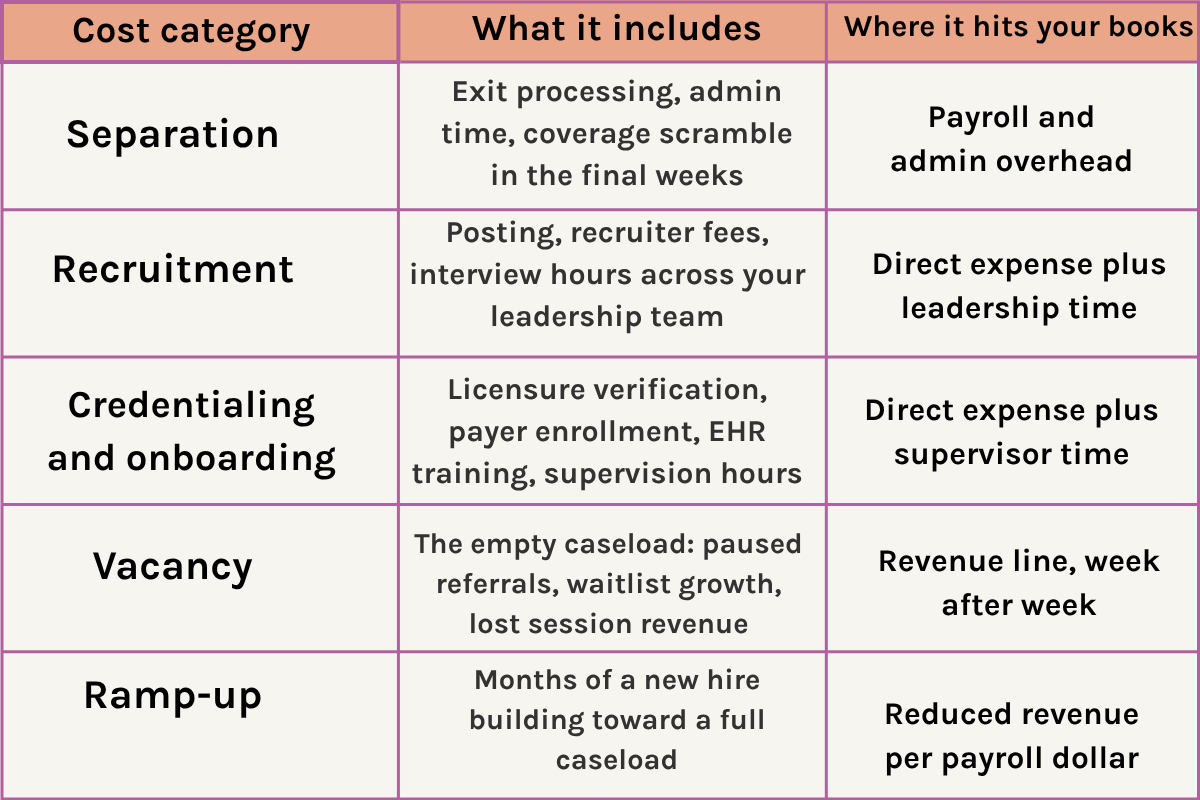
One departure is not a single expense. There are five expense streams running at once, and only two of them are visible before it happens.
What Is The Turnover Rate In Behavioral Health
Annual turnover in community behavioral health agencies is estimated at 30 to 50 percent, with some estimates higher (Brabson et al., 2020). Even the most conservative estimate, 30 percent, is three times the 10 percent annual turnover generally considered healthy (Herschell et al., 2020).
Behavioral health does not have a turnover problem in the way most industries use that phrase. It has a turnover norm that would be treated as an emergency anywhere else. A systematic review of workforce turnover in community behavioral health agencies describes rates as chronically high, with detrimental effects on the agency and remaining staff (Brabson et al., 2020). In a mixed-method study of community behavioral health settings, Herschell and colleagues (2020) note that even the most conservative estimate of 30 percent runs three times the 10 percent considered ideal, and studies embedded in treatment implementation trials have documented rates from 25 percent at one year to nearly 50 percent at eighteen months. Foundational work in publicly funded settings put the range at 30 to 60 percent annually (Mor Barak et al., 2001), and the federal Bureau of Health Workforce continues to describe behavioral health turnover as persistently high in its most recent workforce brief (HRSA, 2025).
Run those two numbers together for your own organization. If you employ ten clinicians and the field's conservative rate holds, you are budgeting for three departures this year, each costing between half a salary and two salaries. That is not a rare event to absorb. That is an annual line item almost nobody puts in the budget, which is exactly why it keeps getting paid without ever being examined.
Whan Does the Cost of Turnover Actually Begin
The cost of turnover begins months before the resignation, as unaddressed vicarious trauma accrues in a clinician's functioning, engagement, and capacity. By the time notice is given, the decision is typically long made, and the organization has already been paying in reduced presence and rising risk to the surrounding team.
Your books record the cost of turnover on the day the resignation letter arrives. The actual bill opens much earlier. Vicarious trauma, the change that happens in a clinician through sustained empathic engagement with clients' trauma, is a normal and expected part of trauma work, and it arrives in every trauma-exposed workforce whether or not anyone names it. If the term is new territory for you, my complete guide to vicarious trauma covers it in full; what matters for this guide is the timeline. When vicarious trauma goes unnamed and unsupported, it compounds, and its downstream forms, compassion fatigue, secondary traumatic stress, and burnout, are the versions leaders finally see, usually in an exit interview.
The organizational research backs the timeline. A systematic review of organizational factors in secondary traumatic stress found that workplace conditions, including support, culture, and workload, shape how trauma exposure lands on staff (Sutton et al., 2022), which means the months before a resignation are not a private struggle happening off the clock. They are an organizational event, unfolding inside your structures, at cost, without a line item.
The reason you do not hear about it during those months is cultural, and it walks in the door with your clinicians on day one. Helping professionals are trained toward composure, and most absorb the belief early that being affected by the work signals a problem with the professional rather than a property of the work. That belief keeps the struggle silent, which is why your most affected clinician is so often your most composed one, and why the eventual resignation feels like it came from nowhere. It did not come from nowhere. It came from the one place your reporting cannot see. If your organization runs on the assumption that silence means everyone is fine, that assumption is the most expensive one on your books.
What Are the Hidden Costs of Clinician Turnover?
Beyond replacement expenses, clinician turnover disrupts client care, increases load on remaining staff, raises the likelihood of further departures, and removes institutional knowledge that never appears in a job description. These indirect costs are harder to measure and routinely exceed the visible bill.
Client outcomes and engagement
In trauma treatment, the relationship is the intervention, and the research on what happens when a departure cuts it shows two distinct effects. A study following clients in community behavioral health found that therapist turnover predicted increased client non-attendance (Babbar et al., 2018). After a departure, clients simply stop showing up. And a study in Psychiatric Services found the effects of clinician turnover were not uniform, with the most detrimental outcomes concentrated among clients who were doing well at the start of the observation period (Johnson-Kwochka et al., 2020). That finding is the opposite of what most leaders assume. Turnover does its deepest client damage not to the cases already struggling, but to the ones your organization was succeeding with.
The absorbed caseload
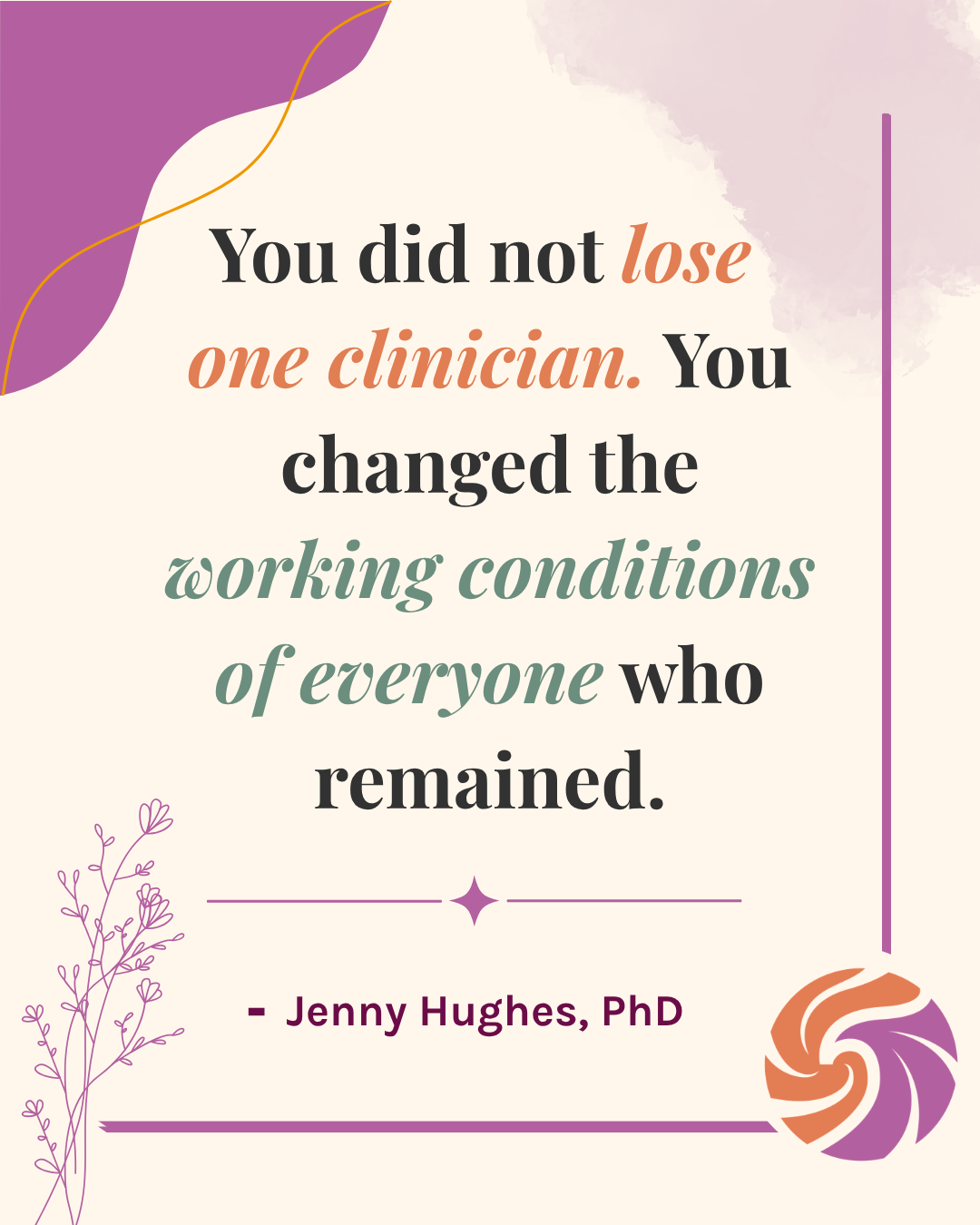
An open caseload does not wait for the new hire. It distributes across the clinicians who stayed, which means every departure increases trauma exposure and workload for the exact people who were already carrying the most. Given that workload and support conditions shape how trauma exposure lands (Sutton et al., 2022), the departure itself becomes a risk factor for the next one. You did not lose one clinician. You changed the working conditions of everyone who remained.
Turnover contagion
One departure changes what the rest of the team imagines for itself. Organizational research calls this turnover contagion: in a multi-organization study outside healthcare, coworkers' job embeddedness and job-search behavior predicted individual employees' decisions to quit, over and above their own job attitudes (Felps et al., 2009). The finding comes from banking and hospitality samples, and every trauma-exposed team I have worked with recognizes it instantly: people who had never seriously pictured leaving start picturing it, because someone just showed them the door works. This is why the second and third resignations deserve more of your attention than the first. The first one hurts. The ones that follow it are information about your system.
Institutional knowledge
The clinician who leaves takes things no job description ever listed: which referral sources answer the phone, how to move a case through the county, which newer clinician needs checking on after a hard session. None of it transfers in a two-week notice period, and your organization keeps paying for its absence long after the replacement signs.
How Do You Calculate the Cost of Turnover in Your Organization?
Estimate turnover cost by totaling five categories for your most recent departure: separation, recruitment, credentialing and onboarding, vacancy weeks multiplied by lost session revenue, and ramp-up months at reduced productivity. Most organizations that run this once find the total lands near or above the departed clinician's annual salary.
You do not need a consultant or a proprietary tool for this. You need one recent departure, your own numbers, and an hour.
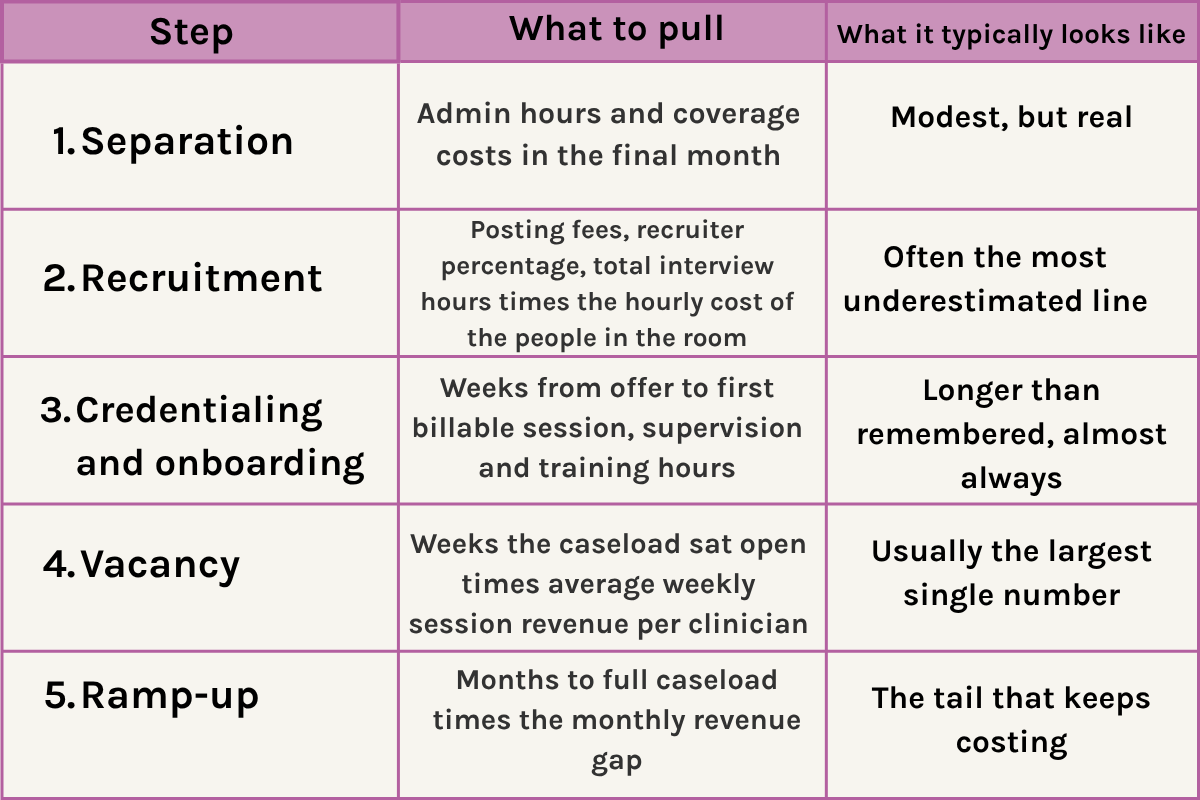
Add the five numbers, then hold the total next to the salary of the clinician who left. The most recent national healthcare retention report puts the average cost of one nursing departure at just over $60,000 (NSI Nursing Solutions, 2026), and organizations that run this exercise on their own books tend to land near or above the departed clinician's annual salary. Then do one more piece of math and multiply by the number of departures you had last year. That figure, not the job posting, is what clinician turnover actually costs you.
Why Don’t EPAs and Wellness Benefits Reduce Clinician Turnover?
EAP utilization is persistently low, with studies reporting rates under 10 percent of eligible employees and many organizations between 2 and 8 percent (Compton & McManus, 2015). For trauma clinicians the model fits poorly, offering brief, resolution-focused care purchased by the employer for what is an ongoing occupational exposure.
Most organizations already have a support line in the budget. An EAP, sometimes a wellness stipend or an app subscription. The spending is real and the intention behind it is real, and the utilization data says your clinicians are largely not touching it. Research on employee assistance programs consistently documents low uptake, with stigma and awareness among the reasons (Fleary et al., 2023), and surveyed organizations commonly report single-digit utilization (Compton & McManus, 2015).
The problem is not the therapists staffing these services, who are colleagues doing legitimate clinical work. The problem is the design of the model they work inside. EAPs offer brief, resolution-oriented care, delivered by a vendor your organization contracts and pays, and every one of those design features collides with who trauma clinicians are professionally. Disclosure, for them, comes after an assessment of safety, because that is how they were trained, and a benefit purchased by the employer rarely passes that assessment when the thing that needs saying is about the job itself. The exposure driving their distress is also not a discrete life event that resolves in a handful of sessions. It is a standing condition of their occupation, and standing conditions call for standing support inside the setting where the exposure happens.
So the gap is not between spending and not spending. It is between support designed for employees in general and the humans in your building who absorb trauma for a living. Once that gap is visible in the EAP line, the same question follows every support your organization offers. Is it built for what this work does to a human, or for a workforce it was never going to fit?
What Actually Reduces Clinician Turnover in Trauma-Exposed Organizations?
Research on trauma-exposed workforces points to organizational conditions, support, culture, workload, and leadership behavior, as the strongest levers for sustaining clinicians (Sutton et al., 2022). Interventions built into existing structures, with leadership participating, outperform benefits that sit adjacent to the work.
When leaders take this seriously, they usually reach for one of two levers. Pay more, or add perks. Pay matters, and paying people fairly is not optional. But the research on why clinicians leave points well beyond salary, to workload, support, and the conditions of the work itself (Brabson et al., 2020), and a study in a large public mental health system found that while financial strain predicted therapist turnover, that relationship disappeared for therapists participating in a system-wide training initiative (Last et al., 2020). Investment in clinicians' professional experience changed whether financial pressure translated into departure. Perks cannot do that, because a stipend or an app sits next to the work while the thing wearing your people down is inside the work.
The third path is building support into the structures you already run. Your team meetings. Your supervision. Your one-on-ones. The way caseloads get discussed, and the way the impact of trauma work gets named out loud by people with authority. The research on organizational response to trauma exposure keeps pointing here: conditions, culture, and leadership behavior are where the leverage lives (Sutton et al., 2022). And this is also where the other side of trauma exposure becomes available. Vicarious resilience, the documented capacity for clinicians to grow through witnessing their clients' healing, emerges most reliably in environments structured to support it; my complete guide to vicarious resilience covers that research in full. The clinicians most exposed to trauma in your organization can be changed by this work in ways that keep them in it, and whether that happens is substantially a function of the environment you run.
This is the argument The BRAVE Method was built on. It is an organizational training where leadership and clinicians learn together, in the same room, so the whole organization leaves with shared language for what this work does to humans, and support gets built into the operation you already run instead of bolted onto it. Trained once, carried out through structures that already exist. If the number you calculated two sections ago is still in your head, this is what moving it looks like: you stop paying for turnover on the back end and start investing where the cost actually begins. You can see how it works at The BRAVE Method.
And if you are a clinician reading a leader's guide because nobody above you has yet, The BRAVE Trauma Therapist Collective is where trauma therapists do this work together instead of alone; you are welcome to join us there.
Vicarious trauma comes with being human in this work, and so does vicarious resilience. Being human is how we stay in the work we love.
Frequently Asked Questions
What is the average turnover rate for therapists and behavioral health clinicians?
Annual turnover in community behavioral health agencies is estimated at 30 to 50 percent, with foundational studies of publicly funded settings reporting 30 to 60 percent (Brabson et al., 2020; Mor Barak et al., 2001). Even the most conservative figure, 30 percent, runs three times the roughly 10 percent annual turnover generally considered healthy for an organization (Herschell et al., 2020). Rates vary by setting, with community and publicly funded agencies typically running higher than private group practices.
How much does it cost to replace one therapist?
Total replacement cost is estimated at one half to two times the departing clinician's annual salary (Gallup, 2019), and the most recent national healthcare retention data puts the average cost of a single nursing departure at just over $60,000 (NSI Nursing Solutions, 2026). For a clinician earning $75,000, that puts one departure between roughly $37,000 and $150,000 once separation, recruitment, credentialing, vacancy, and ramp-up are all counted. Vacancy, the weeks a caseload sits open, is usually the largest single component.
Does clinician turnover affect client outcomes?
Yes, and the research is specific about how. Therapist turnover predicts increased client non-attendance, meaning clients disengage from care after a departure (Babbar et al., 2018). Effects on clinical outcomes are not uniform: one study found the most detrimental changes among clients who were doing well before the turnover occurred (Johnson-Kwochka et al., 2020). In trauma treatment, where the therapeutic relationship carries the intervention, a departure interrupts care at the level of the mechanism itself.
Is high turnover just normal in behavioral health?
High turnover is common in behavioral health, and common is not the same as inevitable. The research points to organizational conditions, workload, support, culture, and leadership behavior, as the strongest influences on whether trauma-exposed staff stay (Sutton et al., 2022; Brabson et al., 2020). Organizations that treat vicarious trauma as a normal, expected occupational reality and build support into their existing structures are working the levers the evidence actually identifies, rather than absorbing the field's turnover rate as a fixed cost.
What does turnover cost beyond the money?
Four costs never reach your books. Clients stop attending or lose progress, caseloads get absorbed by the clinicians who remain, further departures become more likely as the team recalculates its own future, and institutional knowledge no job description ever captured walks out the door. Organizational research on turnover contagion shows that coworkers' departures and job searching measurably increase an employee's own likelihood of quitting (Felps et al., 2009), which is why one resignation so often becomes several.
Why do clinicians leave even when the pay is decent?
Because the drivers the research identifies most consistently are conditions of the work rather than the paycheck, including workload, support, supervision quality, and organizational culture (Brabson et al., 2020). In trauma-exposed settings, unaddressed vicarious trauma compounds those conditions. For the full picture of what drives good clinicians out, see why therapists quit, which covers eight reasons that have nothing to do with pay.
References
Babbar, S., Adams, D. R., Becker-Haimes, E. M., Skriner, L. C., Kratz, H. E., Cliggitt, L., Fernandez, T., & Beidas, R. S. (2018). Therapist turnover and client non-attendance. Children and Youth Services Review, 93, 12-16. https://www.sciencedirect.com/science/article/abs/pii/S0190740918303013 [VERIFY: full author list against the publisher page]
Brabson, L. A., Harris, J. L., Lindhiem, O., & Herschell, A. D. (2020). Workforce turnover in community behavioral health agencies in the USA: A systematic review with recommendations. Clinical Child and Family Psychology Review, 23, 297-315. https://link.springer.com/article/10.1007/s10567-020-00313-5 [VERIFY: page range]
Compton, R., & McManus, J. (2015). Employee assistance programs in Australia: Evaluating success. Journal of Workplace Behavioral Health, 30(1-2), 32-45. [VERIFY: full bibliographic details; utilization range 2.1 to 8 percent confirmed via secondary source]
Felps, W., Mitchell, T. R., Hekman, D. R., Lee, T. W., Holtom, B. C., & Harman, W. S. (2009). Turnover contagion: How coworkers' job embeddedness and job search behaviors influence quitting. Academy of Management Journal, 52(3), 545-561. https://journals.aom.org/doi/10.5465/amj.2009.41331075
Fleary, S. A., et al. (2023). Understanding low utilization of employee assistance programs and time off by US public health workers during the COVID-19 pandemic. https://pmc.ncbi.nlm.nih.gov/articles/PMC10102824/ [VERIFY: author list, journal, and year against the PMC record]
Gallup. (2019). This fixable problem costs U.S. businesses $1 trillion. https://www.gallup.com/workplace/247391/fixable-problem-costs-businesses-trillion.aspx [VERIFY: link resolves; authors McFeely & Wigert]
Herschell, A. D., Kolko, D. J., Hart, J. A., Brabson, L. A., & Gavin, J. G. (2020). Mixed method study of workforce turnover and evidence-based treatment implementation in community behavioral health care settings. Child Abuse & Neglect, 102, 104449. https://pmc.ncbi.nlm.nih.gov/articles/PMC8699177/
HRSA Bureau of Health Workforce. (2025). State of the behavioral health workforce, 2025. https://bhw.hrsa.gov/sites/default/files/bureau-health-workforce/data-research/Behavioral-Health-Workforce-Brief-2025.pdf
Johnson-Kwochka, A. V., Wu, W., Luther, L., Fischer, M. W., Salyers, M. P., & Rollins, A. L. (2020). The relationship between clinician turnover and client outcomes in community behavioral health settings. Psychiatric Services, 71(1), 28-34. https://psychiatryonline.org/doi/10.1176/appi.ps.201900169 [VERIFY: volume, issue, pages]
Last, B. S., et al. (2020). Therapist financial strain and turnover: Interactions with system-level implementation of evidence-based practices. Administration and Policy in Mental Health and Mental Health Services Research. https://link.springer.com/article/10.1007/s10488-019-00949-8 [VERIFY: full author list, volume, issue, pages]
Mor Barak, M. E., Nissly, J. A., & Levin, A. (2001). Antecedents to retention and turnover among child welfare, social work, and other human service employees: What can we learn from past research? A review and metanalysis. Social Service Review, 75(4), 625-661. [Intentionally unlinked pending verification of a stable publisher URL]
NSI Nursing Solutions. (2026). 2026 NSI national health care retention & RN staffing report. https://www.nsinursingsolutions.com/documents/library/nsi_national_health_care_retention_report.pdf
Sutton, L., Rowe, S., Hammerton, G., & Billings, J. (2022). The contribution of organisational factors to vicarious trauma in mental health professionals: A systematic review and narrative synthesis. European Journal of Psychotraumatology, 13(1), 2022278. https://www.tandfonline.com/doi/full/10.1080/20008198.2021.2022278 [VERIFY: link against the Ep 4 guide's verified reference list]