By Jenny Hughes, PhD | Originally published February 2025. Last updated July 2026.
Peer support for trauma therapists is regular, reciprocal connection with colleagues who understand trauma work: consultation, honest conversation, and spaces where being affected by the work is expected. Research links it to lower burnout and higher job satisfaction.
Being a trauma therapist means you're no stranger to holding others' pain. You love the work and the deep healing it fosters, and the emotional toll can still leave you isolated and drained. You know you're "supposed to" take care of yourself. You teach your clients to prioritize it. Actually doing it is another story.
I've been there, right on the edge of burnout, convinced I had to go it alone. What changed things wasn't more self-care, though self-care matters. It was connection. It was leaning into peer support, finding people who truly understand what it means to sit with trauma every day, and letting them hold space for me too.
Why does peer support matter for trauma therapists?

Therapists who engage in regular peer consultation report lower burnout and higher job satisfaction. Connection buffers the isolation that makes vicarious trauma harder to carry.
This isn't just my opinion. There is a clear empirical knowledge base on the importance of peer support for therapists, and it consistently shows that those who engage in regular peer consultation experience lower rates of burnout and higher job satisfaction. Connection protects us, providing a buffer against the isolation that can make vicarious trauma feel unbearable.
Yet for many of us, reaching out for support is complicated. It's not just about finding time. It's about the internalized belief that needing help somehow means we're not cut out for this work. That belief is one of the most common things trauma therapists carry, and the more you connect, the more clearly you see it for what it is: conditioning, not truth.
Is peer support actually mental health care?
Yes. Co-regulation is a nervous system process, not a luxury. Being genuinely seen by a colleague who understands trauma work produces measurable physiological settling.
You probably say this to your clients all the time: regulation happens in relationship. Co-regulation isn't weakness, it's human. So when's the last time you let yourself receive that kind of care?
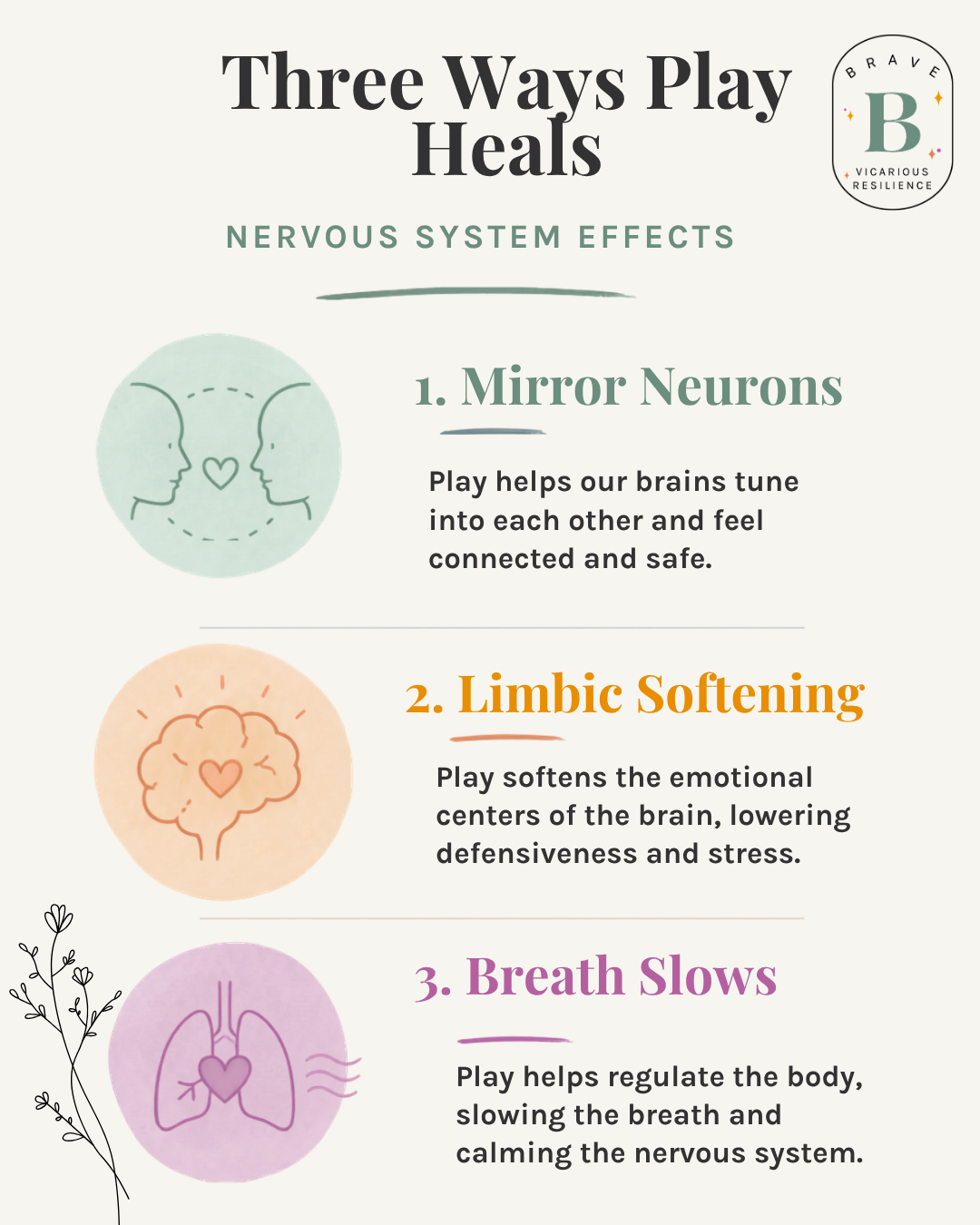
Real peer support, the kind where a colleague looks at you and says "yeah... same," can do more for your nervous system than a dozen checklists or self-help podcasts. Mirror neurons fire when you're with someone who resonates. The limbic system softens when you're seen and understood. Your breath slows before your brain even registers what's happening. That's not magic, that's biology. It's your nervous system finally hearing: you're safe, and you're not the only one.
What does peer support look like?
Peer support ranges from a quick text after a hard session to structured consultation groups. The form matters less than the reciprocity and the safety

The beauty of peer support is that it can take many forms to meet your needs. Sometimes it's a quick text to a colleague after a particularly hard session or day. Other times, structured spaces are needed, like reflective supervision groups or formal case consultations. Casual interactions matter too. A simple coffee chat can offer the gift of being seen without needing to solve anything.
Sometimes the most powerful moments are the smallest ones. A voice memo from a colleague that helps you exhale. A three-word DM: "You're not wrong." The pause after a session when you sit with your dog on the back steps and remind yourself that you don't have to carry this alone.
For me, the most meaningful moments of connection have happened inside The BRAVE Trauma Therapist Collective. A few weeks ago, something happened there that hit me right in the chest. A longtime member returned to our asynchronous consultation group after being quiet for a while. Nothing dramatic, just life, work, the rhythm of being a therapist in this world. When she came back, she said: "I'm here because I finally decided I don't have to pretend I'm better off figuring these complex cases out alone."
She dropped a thoughtful, layered clinical question into the chat, and within hours a wave of support came back. People didn't just give advice. They offered presence. They said "you're asking the right questions." They shared encouragement, humor, and a few cat pictures. That's what peer support really does. It doesn't erase the hard. It makes it survivable.
And if you've stepped back from your own peer community lately, that doesn't mean you're disconnected. It means your system did what it needed to do. What matters is knowing you can come back, and that you'll still be received.
What gets in the way of peer support
The most common barriers are unsafe professional spaces, time, and the belief that needing support means you're not cut out for the work. All three are workable.
Reaching out isn't always easy, especially when you're a trauma therapist. For years, I was lucky to have a network of therapist friends who understood the work I was doing, who understood me. But when I began working in an unhealthy environment, that changed. I didn't feel safe being open with others and gradually cut myself off. It wasn't until I hit total burnout, and the pandemic turned everything upside down, that I knew something had to change.

That's when I created BRAVE, because I didn't want other trauma therapists to feel as isolated as I had. In building it, I began opening up again and rediscovered how necessary it is to have a community of therapists who truly get it. Today I count so many of my closest friends as fellow therapists. Getting here wasn't easy, and I know the barriers that hold many of us back.
Sadly, many therapist spaces aren't safe, a theme that shows up online and in person. I've written about why some therapist spaces feel unsafe and the green flags of a genuinely safe consultation group. They're not all that way. If you're feeling hesitant about peer support, know this: it's okay to start small, it's okay to take your time, and it's okay to seek a space where you feel truly understood.
It's also worth naming that access to peer support isn't evenly distributed across our field. Who has mentors, consultation, and professional community is shaped by systems, not just personal effort. I've written about the equity gap in peer support and what we can do about it together.
Reflection exercise: take your first step
Start with what you already know about yourself. You have evidence about what connection does for your system; the work is doing it more deliberately.
Who is one colleague you trust enough to send an honest text after a hard day?
What type of group or community could you explore to connect with others who understand this work?
Could you create your own supportive ritual, like a short call with a trusted peer every other week?
What's your first step? Start there and let the ripple effect of connection do its work.

You don’t have to do this alone
Peer support isn't about fixing everything. It's about being human together.
If you're ready for a space created for trauma therapists like you, where consultation is honest and being affected by the work is expected, come see The BRAVE Trauma Therapist Collective: consultation calls, guest expert trainings, and a community of trauma therapists who carry this work together. There's a free tier, so cost doesn't have to be the barrier. Come join us, and if you want somewhere even smaller to start, the free Vicarious Trauma Tracker is a five-minute weekly practice for naming what the work is bringing up.