The Equity Gap in Trauma Therapy: Why Peer Support Is a Systems-Level Issue
Access to peer support in trauma therapy is shaped by systems, not just personal effort. Equity means every therapist gets the specific resources, access, and community support they need, and its absence is a major driver of who stays in the field and who quietly leaves.
If you're a trauma therapist, you've probably felt it: the quiet, underlying sense that the support you need is just out of reach. Consultation, mentorship, a space to be honest about the impact of this work. It's often treated as something you have to earn rather than something built into the profession.
That's not an accident. Major systemic issues have created an uneven playing field in trauma therapy, making access to professional support inconsistent at best and exclusionary at worst. These inequities harm individual therapists and weaken the field as a whole. Peer support isn't a luxury. It's a system of sustainability that determines who thrives in this work and who burns out.
What happens when equity is missing?
When equity is missing, trauma therapists leave the work they love, not because of the work itself, but because of barriers around it: isolation, financial strain, and carrying systemic burdens alone.
When equity is missing in trauma therapy, it doesn't always look loud or dramatic. More often, it looks like brilliant, compassionate trauma therapists quietly leaving the work they love. Not because they can't handle the weight of the stories they hold, but because the systems around them make it almost impossible to stay.
The barriers take many forms: barriers tied to cultural and religious backgrounds, to geography, to the access (or lack of it) therapists have to mentors who can lift them up. Without equity, trauma therapists face professional isolation, financial strain and limited access to training, and emotional exhaustion from carrying systemic burdens alone.
And when trauma therapists leave the field, their absence is felt far beyond their own careers. Clients lose access to care from professionals who share their lived experiences. Communities lose trauma-informed support. The entire field becomes less sustainable, less diverse, and less equitable.
What does equity actually mean in trauma therapy?
Equity is not equality. Equality gives everyone the same thing; equity gives every trauma therapist the specific resources, access, and community support they need based on their unique barriers and circumstances.
Equality means everyone gets the same thing. Equity means every trauma therapist receives the specific resources, access, and community support they need, based on their unique barriers and circumstances. Equity isn't extra. Without it, trauma therapists are asked to carry the weight of the world without the tools or community they need to keep going.
How do systems shape a therapist's access to support?
Bronfenbrenner's Ecological Model shows support access operating at five levels, from your immediate consultation relationships to field-wide policies and generational shifts in training.
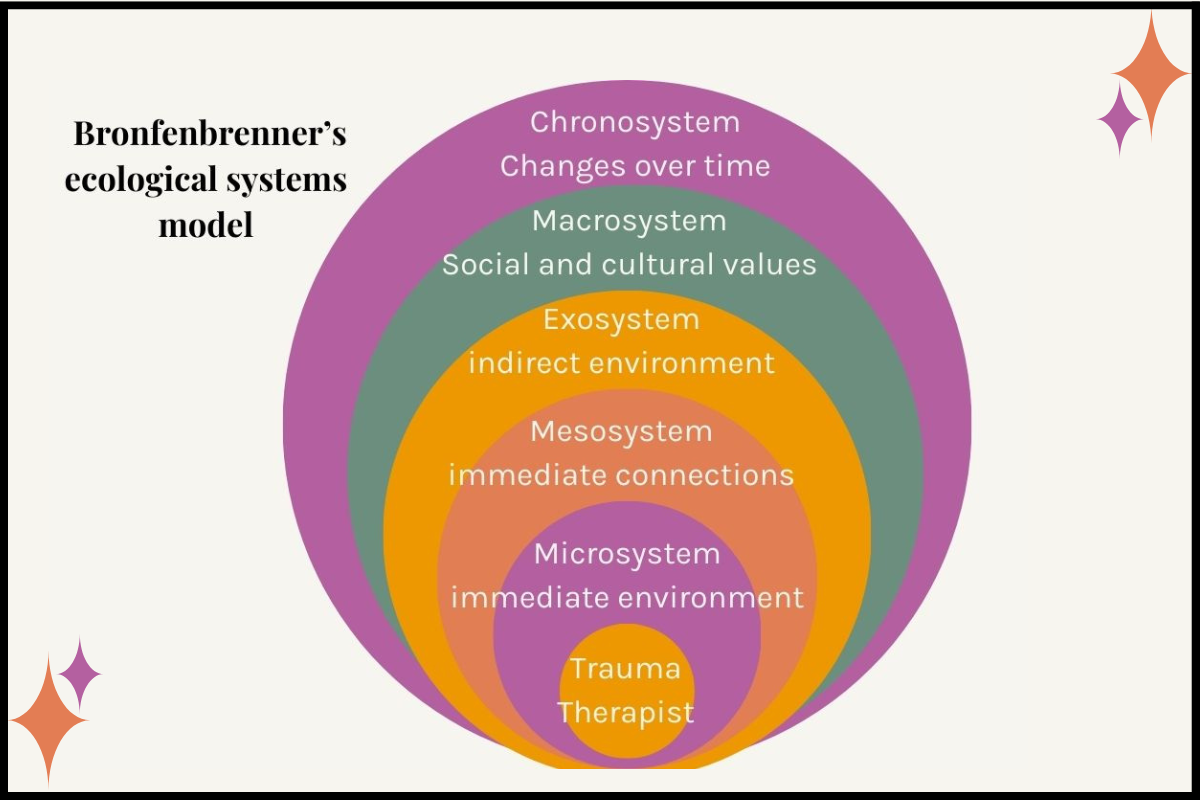
Trauma therapists exist within a network of forces that either sustain or erode their well-being. Using Bronfenbrenner's Ecological Model, you can see how different layers of influence determine access to support:
Microsystem: the immediate relationships shaping daily experience: colleagues, supervisors, consultation groups. If you've ever gone into session feeling more prepared because of a solid consultation beforehand, that's the microsystem at work.
Mesosystem: the connections between those relationships, like whether your workplace supports (or quietly punishes) time spent in consultation.
Exosystem: the settings you don't control but that control your access: agency budgets, licensure requirements, insurance structures.
Macrosystem: the field-wide culture and policies that decide whose training gets funded and whose needs get named.
Chronosystem: the element of time: how policies, treatment approaches, and generational training shifts affect therapists at different career stages. If the field feels different now than it did ten years ago, that's the chronosystem shifting beneath us.
Why is peer support a structural issue, not a personal choice?
Career sustainability in trauma therapy is structural. Therapists with strong networks get mentorship, consultation, referrals, and growth; therapists without them get told to try better boundaries.
For too long, the burden of sustainability in this field has been placed on individual therapists. We're told burnout can be avoided with better boundaries, self-care routines, or a mindset shift. Personal strategies matter, but they're not enough.
The presence or absence of peer support actively shapes who gets to build a long-term career in trauma therapy. Therapists with strong networks have access to mentorship, consultation, referrals, and opportunities for career growth. Therapists without that access are left to white-knuckle the same work with fewer resources, and then blamed for the exhaustion that follows. If you want the individual-level picture of what connection does for your system, start with peer support for trauma therapists. This post is about the layer above it: who gets that support in the first place.
This structural lens also runs through decolonizing trauma therapy and the intersection of racial trauma and vicarious trauma, if you want to go deeper on how identity and systems shape this work.
Personal reflection: audit your own access to support
Take a moment to assess where you are in this system. Grab a piece of paper and answer these questions:
Who do I turn to for professional support?
Is my network diverse, or do I only have access to a limited group of perspectives?
On a scale from 0 to 10, how much systemic support do I actually have? (0 = no access, 10 = fully supported)
Once you've assigned yourself a number, consider these next steps. If you rated yourself a 7 or higher: how can you extend your access to others? Could you mentor a newer therapist, offer consultation spaces, or amplify colleagues who are often overlooked? If you rated yourself below a 7: where do you feel most isolated in your work, and what kind of support would make the biggest difference right now? Whether it's joining a consultation group, reaching out to a colleague, or engaging a professional community, small steps lead to significant shifts.
Moving from awareness to action
We don't have to accept the status quo. Here's how the field starts shifting toward something more equitable and sustainable:
For therapists with access to systemic support: offer mentorship, referrals, and professional inclusion to those with fewer resources.
For therapists seeking access: identify small, strategic steps to expand your professional network in ways that work for you.
For all of us: advocate for workplace and field-wide changes that make peer support an expectation, not an exception.
Equity in trauma therapy doesn't happen passively. It happens when we actively create spaces where therapists have the support they need, not just to survive, but to stay. That's part of why The BRAVE Trauma Therapist Collective exists: a space where peer support is structured, where therapists with high access connect with those with less, and where consultation and education aren't things you have to earn. Come build it with us.
And if you're ready to take one concrete step today: one of the most powerful ways to put your commitment to equity in writing is an Anti-Racism and Anti-Oppression In All Forms Statement, not just as a document, but as a guiding principle for how you show up as a therapist. My colleague Tawanna Marie Woolfolk and I created a free workbook to help you craft a statement that aligns with your values. [Grab your free workbook here.](CARRY OVER EXISTING WORKBOOK LINK FROM THE -hj POST)
Every intentional step dismantles a barrier, strengthens our professional community, and builds a foundation of equity and resilience for trauma therapists everywhere.