7 Things the Best Vicarious Trauma Trainings Have in Common
Most vicarious trauma trainings fail quietly. Not because organizations don’t care, but because they’re solving the wrong problem
I've watched organizations pour money into wellness retreats, meditation app subscriptions, and team lunches thinking they're addressing vicarious trauma, and then they wonder why their therapists are still burning out and leaving.
The problem isn't that these organizations don't care, the problem is that nobody taught them what actually works.
If you're a leader who has done those things, I'm not here to make you feel bad about that. You did what you were told would help: you followed the playbook that the industry handed you. But the playbook is incomplete.
The trainings that actually change something share seven specific things in common. And if you're evaluating training options for your team, or you're a therapist trying to advocate for better support at your organization, these are the things to look for.
What Makes a Vicarious Trauma Training Effective?
The best vicarious trauma trainings address the system, give teams shared language, include leadership, extend beyond a single day, measure real outcomes, normalize vicarious trauma, and build toward vicarious resilience rather than just coping.
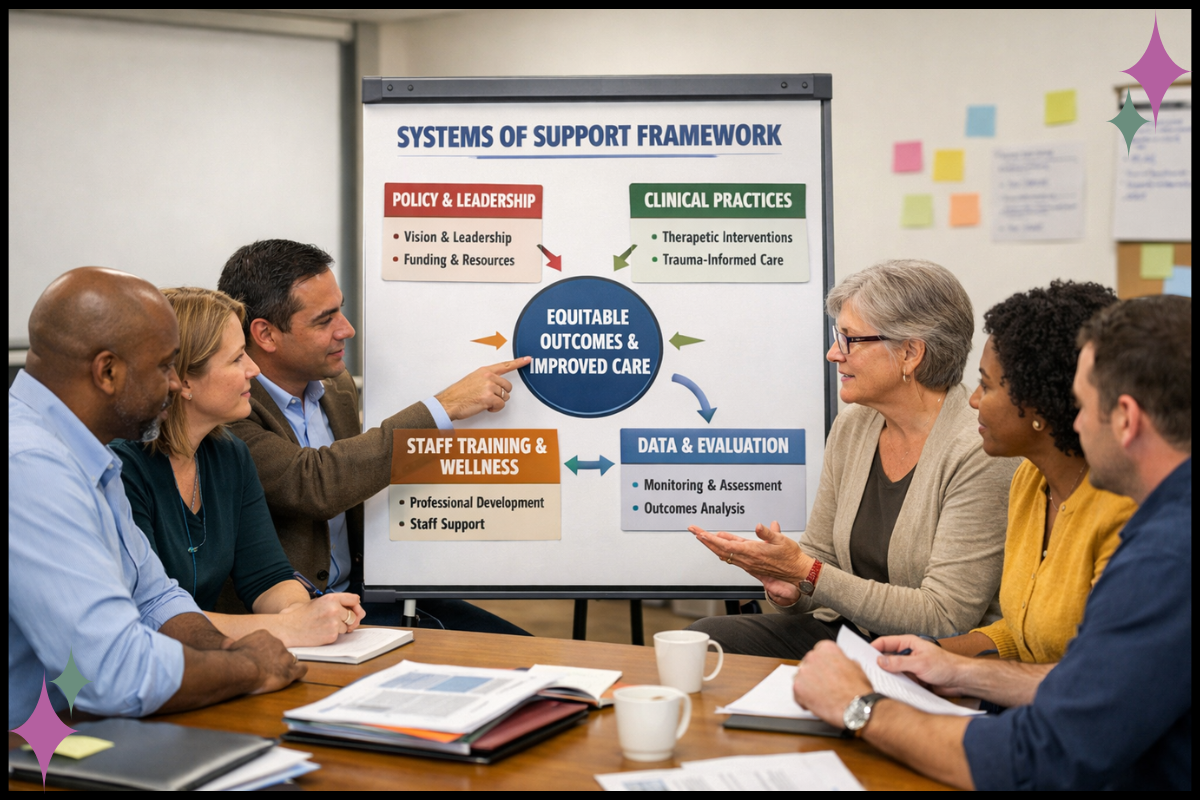
Most of what gets offered to trauma-exposed teams treats vicarious trauma as an individual problem with individual solutions. The trainings that work treat it as what it is: a systemic, occupational reality that requires an organizational response.
Here's what that looks like in practice.
1. They Address Vicarious Trauma as a System Problem, Not an Individual One
The best vicarious trauma trainings treat vicarious trauma as a system problem requiring an organizational response, not an individual problem requiring better self-care.
This is the foundational difference, and it's the reason most trainings don't stick.
When I talk to organizational leaders about what they've already tried, I hear a lot of the same things.
They offer PTO. They have an EAP.
They got their team access to the Calm app.
They did a team retreat last year.
They offer consultation every week, but people either don't come or they don't really talk about their cases.

Those things are not bad. I genuinely praise leaders for trying, because they're doing what the industry has told them to do. But here's the gap.
An EAP does not address the cultural problems within an organization that make clinicians feel unsafe in consultation spaces. A meditation app is not going to regulate a therapist who feels isolated even when they're surrounded by others. And a one-day retreat is not going to undo what's been building in someone's nervous system for months or years.
These are individual solutions to a problem that lives in the system. When they don't work, leaders often assume their staff aren't taking advantage of the resources.
The truth is, the resources were never designed for the actual problem.
The best trainings ask a fundamentally different question. Not "how do we get our therapists to take better care of themselves?" but "what is happening in this organization's culture, communication patterns, supervision structure, and daily workflow that is making vicarious trauma harder to hold?"
That shift changes everything.
2. They Give Teams a Shared Language for Vicarious Trauma and Vicarious Resilience
Effective vicarious trauma trainings give teams a shared vocabulary for both vicarious trauma andvicarious resilience, so the impact of trauma work can be named, discussed, and addressed together.
Without shared language, every conversation about the impact of trauma work stays vague. Or it just doesn't happen at all.
One of the most powerful things I see happen in trainings is when people learn the term vicarious resilience for the first time. For a lot of clinicians, this is a brand new concept. They've heard of vicarious trauma, they've heard of burnout, they may have heard of compassion fatigue and secondary traumatic stress. But vicarious resilience? That's new.
And learning it does double duty. It normalizes vicarious trauma, because now there's a framework where VT isn't just this terrible thing that means something is wrong with you. It's one side of an experience that has another side. And it gives teams shared language to actually talk about both.

When a therapist is isolating, or they're more irritable than usual, or they're avoiding work or overworking, the team already knows those are normal parts of vicarious trauma. They have words for it. They can name it without shame.
On the other side, when a therapist tears up in session because they're proud of a client, or they feel that warmth after watching someone reclaim something that trauma had taken, they have language for that too. They can name it as vicarious resilience. They can share it with their team. They can celebrate it together instead of letting it pass by unnoticed.
That shared language becomes the foundation for everything else. Without it, you're asking people to talk about something they don't have words for. And most people won't.
3. They Include Leadership in the Room
The best vicarious trauma trainings require leadership to participate alongside frontline staff, not just send their team and wait for results.
When leadership sends the team to a training but doesn't attend, it sends a very specific message: this is your thing to fix. It offloads the responsibility onto clinicians and their direct supervisors and hopes the culture shifts because the employees went to a workshop.
That's asking for change from the bottom up. Lasting organizational change doesn't work that way, it has to come from the top down.
Leadership has to be in the room learning the same framework, hearing the same language, and then modeling it in how they run supervision, how they respond to struggle, how they structure the workday.
It's an interesting contrast with what's happening in trauma therapy right now.
In clinical work, we're moving toward bottom-up processing, starting with the body and working up through cognition. But organizational change works the other direction. Leadership sets the tone, leadership creates the conditions, qnd if they're not part of the training, those conditions don't change, no matter how good the training was for the people who attended.
The best trainings don't let leadership opt out, but rather, they build leadership into the design.
4. They Go Beyond a Single Day
The best vicarious trauma trainings include follow-up, check-ins, and ongoing support so that learning translates into sustained culture change rather than fading within weeks.
Here's what happens after a one-day training when there's nothing that follows it. The first thing that fades is the hope. The hope that things can actually change for the individual and for the organization.
When people attend a good training, they leave feeling something. They feel seen, they feel less alone, they feel like maybe things could be different. That matters. But when they go back to work the next day and nothing around them has changed, that feeling starts to erode. And once that hope is gone, everything goes back to business as usual.
People continue moving through that cycle: vicarious trauma to compassion fatigue to secondary traumatic stress to burnout. And now there's an added layer, because they had a moment where things felt possible, and it didn't last.
That makes the next training even harder to trust.
The best trainings have something built in after the initial day. Follow-up. Check-ins. Ongoing support. Not because people can't remember what they learned, but because implementation takes time and reinforcement. A team doesn't build a new culture in four hours. They start one, and then they need support to keep building it.
5. They Measure Real Outcomes, Not Just Satisfaction
The best vicarious trauma trainings use anonymous pre and post measures to track real shifts in vicarious trauma, burnout, and compassion satisfaction over time, not just whether attendees enjoyed the training.
Most trainings end with a feedback form. Rate this training one to five. What did you enjoy most? What would you change? Those forms are fine for what they are. They give the trainer feedback on how the training went.
But they don't tell you anything about whether something is actually changing.
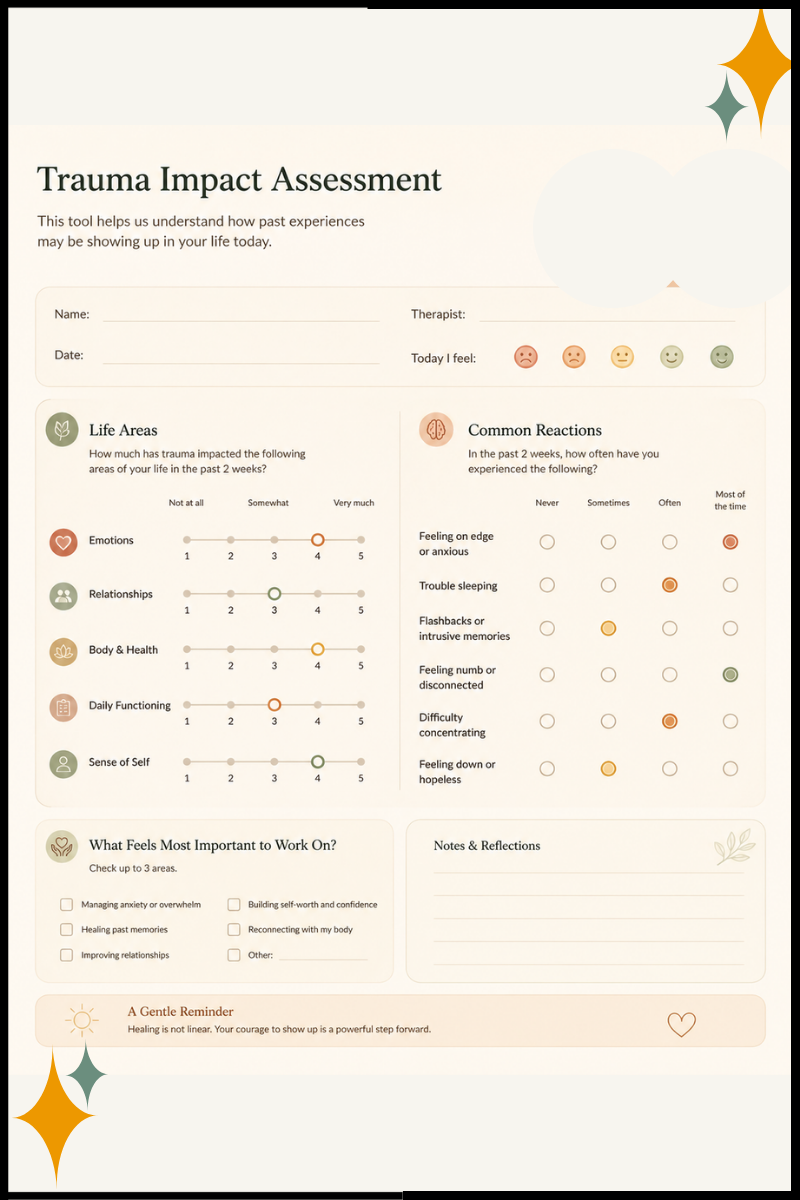
The best trainings use pre and post measures, and they need to be anonymous, because without anonymity, you're not getting honest data; you're getting people telling you what they think you want to hear.
Pre-measures give you a real picture of what your team is actually experiencing when it comes to vicarious trauma, secondary traumatic stress, burnout, and compassion satisfaction. They give you a baseline. Post-measures, taken weeks or months later, tell you what's shifting and what isn't.
That's where the real value is. Not in whether people liked the training, but in whether the training moved anything.
And if something isn't moving, you can make modifications: you can adjust, you can respond. That only works if you're measuring the right things from the start.
6. They Normalize Vicarious Trauma Instead of Pathologizing It
The best trainings start from the position that vicarious trauma is a normal, expected occupational response to empathic engagement with suffering, not a sign of weakness or professional failure.
This one matters more than people realize.
When vicarious trauma is taught as something to avoid, as something that means you're not cut out for this work, or that you're too sensitive, or that you need to learn how to leave it at the office, it doesn't help, but rather, it shuts therapists down, it encourages them to disconnect from the work they love, to disconnect from their clients, and to white-knuckle their way through each day.
That's the opposite of what a training should do.

When everyone in the room is on the same page that vicarious trauma is a normal response to doing deeply human work, something shifts. It connects back to shared language and it makes it okay to actually use that language together as a team.
People stop hiding, they stop performing fine, and the isolation that makes vicarious trauma so much harder to carry starts to loosen.
Normalizing vicarious trauma doesn't mean ignoring it. It means creating the conditions where people can actually talk about it without shame. That's the starting point for everything that follows.
7. They Build Toward Vicarious Resilience, Not Just Coping
The best vicarious trauma trainings teach vicarious resilience as a renewable source of meaning and sustainability that's already present in clinical work, rather than adding more coping strategies to an already full plate.
This is the piece that most trainings skip entirely. And it might be the most important one.
A lot of what gets offered to trauma therapists in the name of support is really just coping strategies. Journal, meditate, set better boundaries, exercise. Those things aren't bad. But for most therapists, they feel like one more thing to add to an already impossible to-do list.

Vicarious resilience is different. It's not another task but a renewable energy source that's already happening in your sessions. Every time you sit with a client and witness their courage, every time you watch someone reclaim something that trauma had taken from them, every time you feel your own heart shift because of what you're seeing in the room, that is vicarious resilience.
But therapists can't access it until they learn it exists. We are trained to track pain, trained to notice risk, to monitor for crisis, to attune to suffering. We are not trained to hold onto the moments that fill us back up. So they pass by unnoticed, unnamed, unclaimed.
A training that teaches vicarious resilience changes that. It gives you the ability to notice what's already there, to name it, and to let it actually land. Not as another task. Not as homework but as something you're already receiving in any given session.
That's the difference between surviving this work and staying connected to why you chose it.
What to Look for When Choosing a Vicarious Trauma Training
If you're evaluating vicarious trauma training options for your organization, these are the seven things that separate the trainings that create real change from the rest:
A systemic approach
Shared language
Leadership involvement
Ongoing support beyond one day
Outcome measurement
Normalization over pathologizing, and
A focus on building vicarious resilience.
None of these seven things are about getting therapists to try harder. None of them are about adding more to anyone's plate. The best vicarious trauma trainings aren't about asking more of the people who are already giving everything but about building something around them that actually supports the work they're doing.
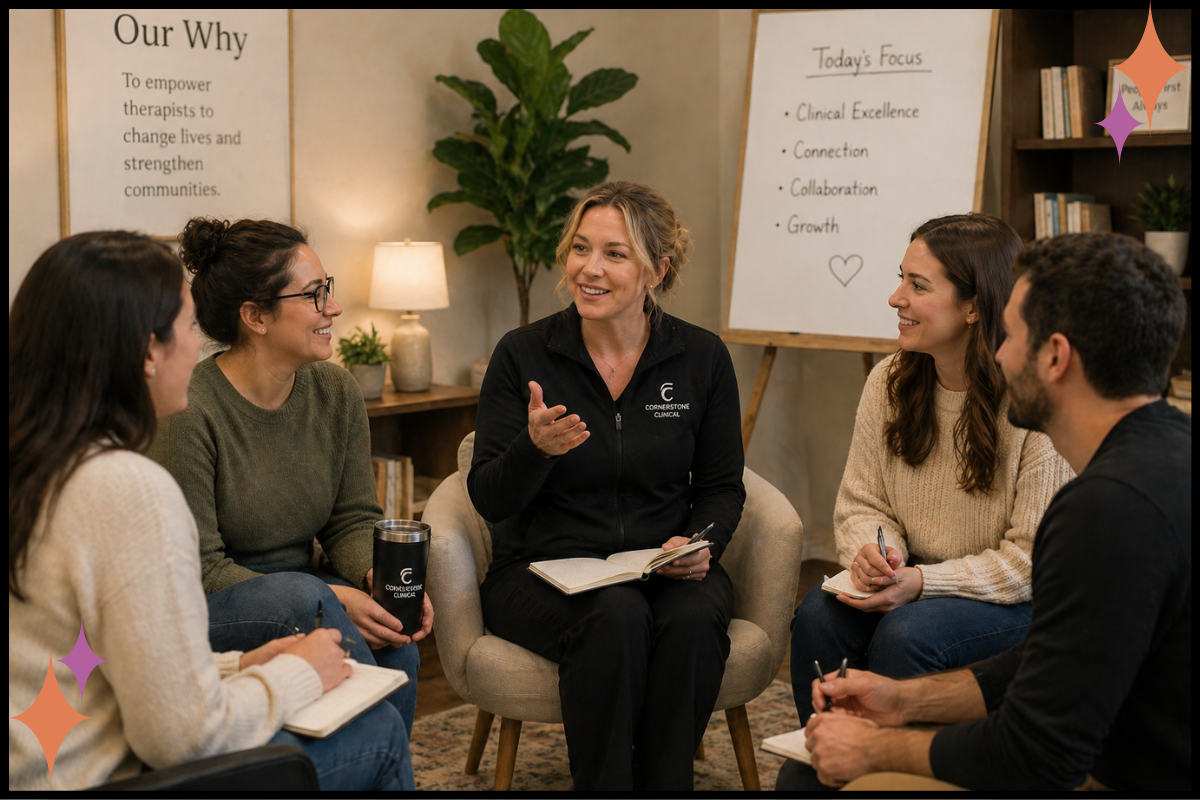
If you're a therapist reading this and recognizing that your organization is ready for this kind of training, that recognition matters. You have your hand on the pulse and you deserve to work in a system that takes this seriously.
And if you're a leader reading this, you don't have to figure this out alone. That's the whole point, right? Trauma therapists were never meant to do this work in isolation. And the organizations that support them weren't meant to figure it out without help.
Where to Start
Everything in this article is what the BRAVE Method was built to do.The BRAVE Method is an evidence-informed organizational training grounded in the framework of Name It, Tame It, Reframe It, designed to help trauma-exposed teams build real, lasting resilience. If you want to see what this looks like for your organization,schedule a time to talk.
If you're not at the organizational training stage but you want support right now, the Vicarious Trauma Tracker is a free tool that helps you start noticing and naming what you're carrying. And the Vicarious Resilience Tracker helps you practice holding onto the moments that fill you back up.
If you're looking for a community of trauma therapists who get it, The BRAVE Trauma Therapist Collective is where trauma therapists come to be human together. Consultation, education, and a community that actually understands the weight of this work.
You can also find me on YouTube and Instagram for weekly content on vicarious trauma, vicarious resilience, and staying in the work you love.