The Supervision Trauma Therapists Actually Need
What Trauma Clinicians Actually Need From Supervision (And Rarely Get)
You've just finished back-to-back sessions. One client disclosed new trauma. Another was dysregulated the entire hour. You're supposed to be writing notes, but you're staring at the screen, replaying a moment you're not sure you handled right.
And then your supervision session rolls around.
You bring a case. You talk about interventions. You leave with a plan. But something essential never gets addressed. You. How you're doing. What you're carrying. Whether the work is starting to cost you something you can't name.
Most clinical supervision was designed to supervise cases. It was not designed to support the person holding those cases. And in trauma work, that gap shows up fast.

Here's what the research and clinical experience tell us: the quality of supervision matters more than the quantity. How supportive and safe it feels matters more than how many hours you log. That's good news for supervisors. It means small shifts in how you show up can make a real difference.
This article offers 10 evidence-based ways clinical supervisors can actually support trauma clinicians. Not just supervise them. Support them. Because those are not the same thing.
Let Them Be Human First, Clinician Second
Supporting a clinician means creating space for them to be human first and professional second. It means asking about the person, not just the work.
There's a phrase from the reflective supervision literature that captures this perfectly: "How you are is as important as what you do." In trauma work, this means creating space for your supervisees to not be okay sometimes, and not treating that as a performance problem.

If your supervision only has room for clinicians to perform competence, they will perform competence. But they won't tell you when they're drowning. They won't tell you when a case is following them home. They won't tell you when they're starting to question whether they're cut out for this work.
And then you lose them. Not because they weren't capable. But because no one made it safe to be human.
Why Does Modeling Uncertainty Matter More Than Expertise?
Modeling uncertainty gives your supervisees permission to be learners rather than performers. Research on parallel process shows that how you show up in supervision shapes how they show up in the therapy room.
Parallel process is this idea that dynamics flow in both directions. What happens between the client and therapist often shows up between the therapist and supervisor. And what happens in supervision gets carried back down into therapy.

If you model certainty and control, that's what your supervisees will feel pressure to perform. With you and with their clients. But if you model curiosity and uncertainty, if you say things like "I don't know, let's think about this together," you give them permission to bring the cases they haven't figured out. The ones keeping them up at night.
The best supervisors say things like, "That's a hard one. I'm not sure either. Let's sit with it." That doesn't make supervisees trust you less. It makes them trust you more.
Supervise the Case AND Support the Person Holding It
Supervising the case means discussing interventions, conceptualization, and treatment planning. Supporting the clinician means checking in on how they're doing while holding that case. These are two different conversations.
Traditional supervision was built around case consultation. You bring a case, you discuss it, you make a plan. That's important. That's part of the work.
But trauma-informed supervision adds a second layer. How is the person holding the case?

You can have a supervisee who is doing all the right things clinically. Using the right interventions. Documenting well. And they can still be slowly drowning under the weight of what they're holding.
If you never ask about the second layer, you won't know. Build both into your supervision. Supervise the case and check in on the person holding the case. Make both normal. Make both expected.
The Questions That Actually Get Real Answers
Questions about the body get real answers. "How are you?" gets a professional script. "Where are you noticing this case in your body?" gets honesty.
"I'm fine. Busy, but fine." That's not information. That's a performance.

But when you ask, "Where are you noticing this case in your body?" you get something real. "My shoulders have been up around my ears all week." "I've had a headache since that session on Tuesday." "I keep holding my breath when I think about seeing them again."
Reflective supervision is built on the idea that self-awareness is what allows therapists to stay present with clients instead of getting hijacked by the material. If your supervisees can notice what's happening in their own nervous system, they can work with it. If they can't, it runs the show.
You can model this too. You can say, "I'm noticing I feel a little activated just hearing about this case. What's that about?" Make the body part of the conversation.
Normalize Vicarious Trauma Out Loud
Therapists often won't name it first. Research shows clinicians avoid bringing up the hardest parts of the work in supervision, even though those are exactly the parts they need support with.

Say it before they have to admit it.
"This kind of case affects people. It would be strange if it didn't."
"Hearing about childhood sexual abuse week after week is going to land somewhere in your system. That's not weakness. That's being human."
"You've been holding a lot of grief this month. That accumulates."
They avoid naming it because it doesn't feel safe. Because they've internalized the idea that struggling means something is wrong with them. You have to make it safe to name. And sometimes that means naming it first.
How Do You Respond Without Pathologizing Their Reactions?
Reframe their reactions as evidence of empathic engagement, not deficits to correct. Trauma-informed supervision moves away from deficit-based models toward a relational, strengths-based approach.

Being affected by trauma work is not a clinical problem to solve. The old models of supervision were often deficit-based: identify what's wrong, fix it. But trauma-informed supervision moves in a different direction.
When your supervisee tells you they cried in their car after a session, the response is not "Let's work on your boundaries." The response is "That makes sense. You just held something enormous. What do you need right now?"
When they tell you a case is following them home, the response is not "You need better compartmentalization." The response is "Of course it is. Let's talk about what kind of support would help."
Their reactions make sense. Help them see that. The shame of thinking something is wrong with them is often worse than thevicarious trauma itself.
Watch for the Signs They're Carrying Too Much
Look for withdrawal, cynicism that wasn't there before, over-functioning, or sudden emotional detachment. These aren't performance issues. They're signals that the accumulation of trauma exposure is taking a toll.
Your supervisees are not always going to tell you when they're struggling. Some of them don't even know. They've normalized it so deeply that they can't see it anymore.
So you have to watch for it.

The research on secondary traumatic stress is clear: the accumulation of exposure matters. It's not about one bad case. It's about the slow buildup over months and years. By the time someone is in full burnout, the damage takes a long time to undo.
If you can catch it earlier, you can intervene earlier. That requires paying attention. Not just to the work they're doing, but to how they're doing while they do it.
What Makes Supervision Feel Safe Enough to Be Honest?
Your response to vulnerability sets the culture. If admitting struggle feels risky, clinicians won't do it. Trust is built through consistent action over time.

When someone takes a risk and tells you they're not okay, what happens next matters more than almost anything else you do as a supervisor. If you meet it with concern and support, they'll come back. If you meet it with worry about their competence, they won't. And neither will anyone else who's watching.
Research on supervision quality shows it's not about how many hours of supervision someone gets. It's about how supportive that supervision feels. Perceived supportiveness predicts compassion satisfaction. Low perceived support predicts burnout.
The question is not "Am I providing enough supervision?" The question is "Does my supervision feel safe enough to be honest in?"
Protect Their Caseload When You Can
Sometimes the most supportive thing isn't relational. It's structural. You can't process your way out of a system that keeps creating more vicarious trauma than any person can hold.
Advocate for reasonable trauma caseload distribution. Push back when someone is being assigned back-to-back high-acuity cases with no buffer. Notice when the same clinician keeps getting the hardest cases because they're good at them, and ask whether that's sustainable.
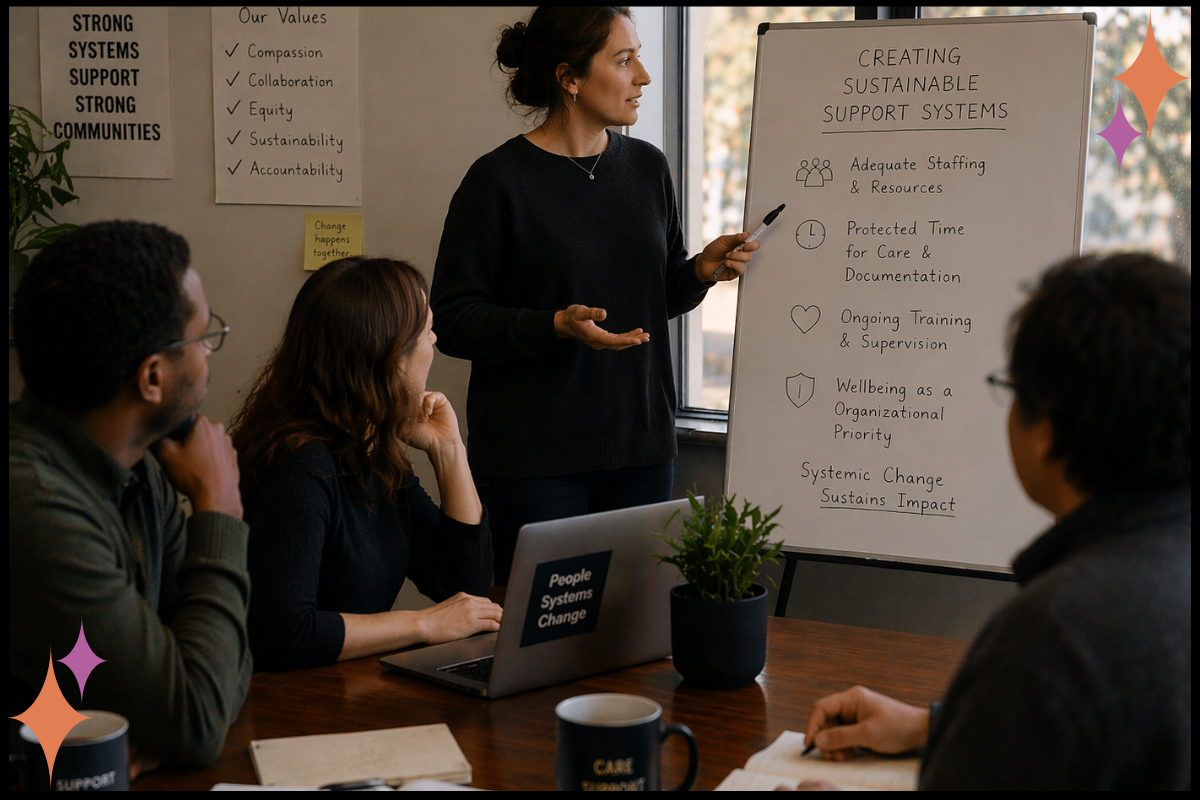
You may not have full control over this. Many supervisors don't. But you have more influence than you think. Using that influence on behalf of your supervisees is part of the job.
It's not enough to help someone process vicarious trauma if the structure they're working in keeps creating more of it. At some point, the system has to change, not just the person's ability to cope with it.
One Supervision Relationship Is Never Enough
Trauma work was never meant to be held alone. Research consistently shows that peer support, consultation communities, and spaces where therapists can be met by others doing the same work are essential for sustainability.
One supervision relationship cannot hold everything trauma work asks of a clinician. You cannot be everything to your supervisees. And you shouldn't try to be.

Part of your job as a supervisor is pointing them toward those spaces. Encouraging them to find their people. Normalizing the idea that they need more support than you alone can provide.
This isn't a failure on your part. It's just the truth about trauma work. Not by the people we serve. And not by us.
If you're looking for a community where trauma therapists come to be human together, that's whatBRAVE is. It's not just for clinicians. We have supervisors in there too who are figuring this out alongside everyone else.
What This Adds Up To
You don't have to be a perfect supervisor. You don't have to have all the answers. What your supervisees need most is permission to be human while they do impossibly hard work. And that permission starts with you.

The research keeps showing us that the quality of supervision matters more than the quantity. How supportive and safe it feels matters more than how many hours you spend together. Small shifts in how you show up can make a real difference.
If you want a simple starting point, try the Vicarious Trauma Tracker. It's a free tool that helps clinicians name what this work costs without pathologizing it. You can use it yourself, share it with your supervisees, or use it as a conversation starter in supervision.
You're doing harder work than most people will ever understand. And you don't have to figure it out alone.