Why Trauma Therapists Can Tell When Wellness Programs Are Failing
A trauma therapist said this to me last week on one of our BRAVE Collective calls. Therapists only ever get recognized right when leadership realizes they're about to quit. And everyone on the call nodded.

That kind of recognition has a flavor, you can taste it in a wellness email that goes out the same week three people give notice. In the pizza party that materializes after a brutal quarter. In the appreciation post on social media that quotes your title but not your name.
You're not cynical for noticing: you're paying attention, and what you're noticing is real.
What Trauma Therapists Notice About Wellness Programs
Trauma therapists notice the timing of wellness initiatives, the gap between what leadership says and what the schedule allows, and whether recognition is woven into the culture or deployed in a crisis.
Pattern recognition is what we do for a living. We track incongruence between what someone says and what their body is doing. We notice the gap between the official story and the real one. We hold attunement as a clinical skill. None of that turns off when we walk into a staff meeting.
So when the wellness initiative shows up two weeks after three people gave notice, we clock it. When the appreciation post drops the same day a colleague gets passed over for a raise, we clock that too. When the meditation app subscription arrives in our inbox the week our caseload was bumped to 32, we definitely clock it.
This is not about being ungrateful, because sometimes pizza parties really do land. They land when there is already a foundation of trust, when leadership has consistently shown through real actions over time that the people doing the work matter. In that context, the pizza is a celebration. In a different context, the exact same pizza can feel like panic.

We can feel the difference.
And once you understand what's actually being clocked, why these programs keep failing, and what changes when an organization stops trying to fix burnout from the bottom up,you can stop carrying this as if it were yours to fix alone.
Why Self-Care Programs Don't Reduce Burnout in Mental Health Settings
Self-care programs don't reduce burnout because they treat a structural problem as an individual responsibility, asking clinicians to absorb pressures generated multiple levels up the system.
Here’s the structural reality: the healthcare system in this country is broken in ways that no individual organization can fully repair. Reimbursement rates have failed to keep pace with inflation for more than a decade, productivity expectations rarely account for the actual emotional labor involved in trauma work, documentation demands have continued to grow while session lengths stayed the same, and workforce shortages are now affecting nearly every corner of the field.
These are not problems that individual clinical directors created, nor are they problems most leaders have the power to solve from where they are standing.
So the burden keeps getting passed downward. The larger healthcare system cannot hold it, so organizations inherit the pressure while operating inside the same strained structure. Organizations then pass that pressure to clinical teams, and clinical teams pass it to individual clinicians. By the time it reaches the therapist sitting across from a trauma survivor, that weight has already traveled through several layers of a system that none of those layers can meaningfully fix on their own.
Now imagine someone hands that clinician a meditation app subscription as the solution. The math doesn't math.

You cannot yoga your way out of structural collapse, and no amount of bubble baths can compensate for reimbursement rates that have not kept pace with inflation in over a decade. Wellness programs are often being asked to carry a level of strain far beyond what they were ever designed to hold.
None of this means organizations or leaders are villains. Most leaders are operating inside the same broken system, doing the best they can with the tools they were given. The problem is the framing itself: when systemic problems are met primarily with individual solutions, the math stops working, regardless of how sincere the intention may be.
When Self-Care Becomes a Weapon
Weaponized self-care happens when "you should take better care of yourself" stops being an offer and starts pointing the finger at the clinician for being burned out. The resource becomes the expectation.
There's a sharper version of this same pattern, one that does real harm. I call it weaponized self-care, and I wrote about it years ago in apiece that's still up on this blog. It's worthyour time if you want to go deeper.
Here's what it looks like in practice, in the specific lines members of theBRAVE Trauma Therapist Collectivehaveshared with me:
A therapist asks for protected admin time to write notes, do treatment planning, and return clinical calls and emails. All things required for the job but not technically billable. The response: you need to manage your time better, that's why you only have 50 minute sessions.
A supervisee asks for more support with a complex case. The response: have you talked to your therapist about your countertransference?
A clinician finally works up the courage to say her caseload is too heavy. The response: try the mindfulness app the organization paid for, between sessions.
None of these are hypothetical.
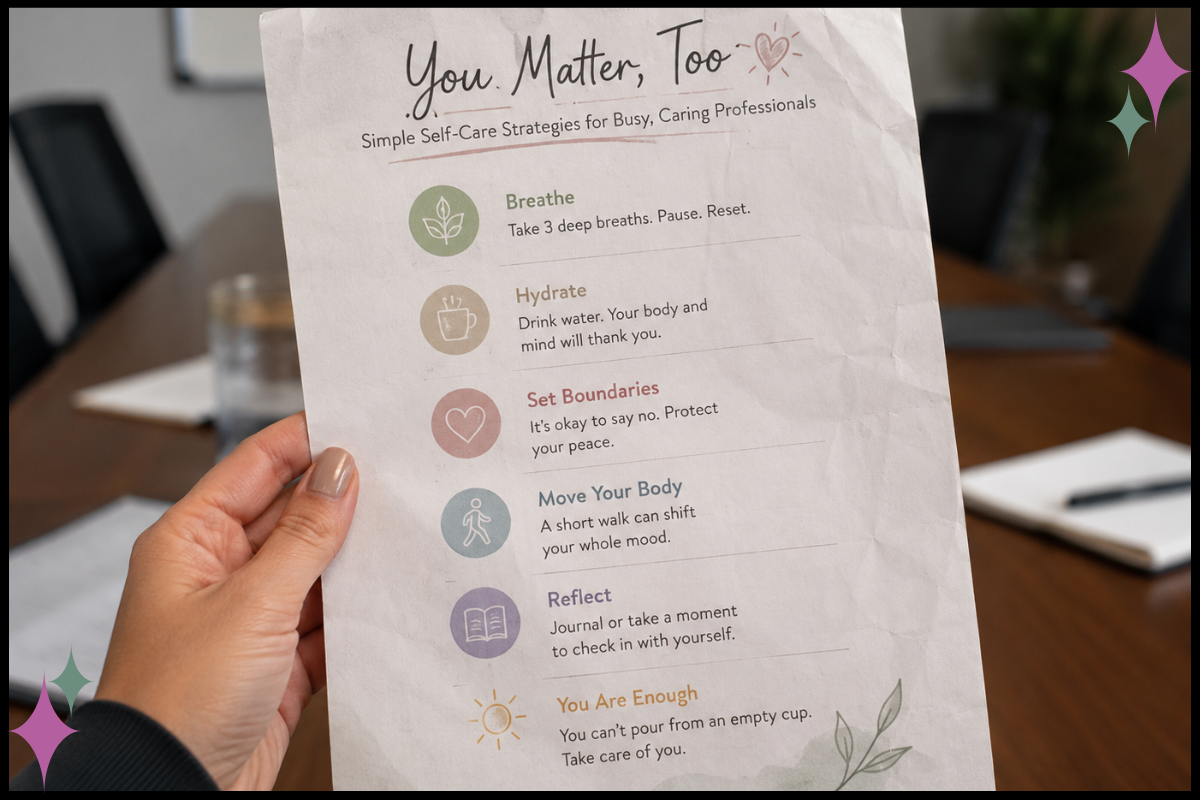
The moment self-care stops being something a clinician can choose, and starts being something leadership uses to deflect from a structural problem, it has stopped being care. It has become the system protecting itself by passing responsibility back down to the person who has the least power to change it.
This matters even more for trauma therapists specifically when you consider the nature of the work itself. We are regularly asked to hold what other systems failed to validate, sitting with clients who have not been believed, whose pain has been minimized, dismissed, or misunderstood long before they ever walked into our offices.
In many cases, we are among the first people to take their experiences seriously, which means the work already asks us to remain deeply attuned to the impact of invalidation and the consequences of not being fully seen.
So when weaponized self-care lands on a trauma therapist, it becomes a parallel process. The clinician now experiences, inside her own workplace, the same dynamic her clients have been told for years. Your suffering is your responsibility to manage.It's not that bad.Have you tried mindfulness.
That parallel is not subtle and it does damage.
What It Looks Like When an Organization Gets It Right
Organizations that successfully reduce therapist burnout treat recognition and clinician care as ongoing cultural practices, not as crisis interventions or one-time programs.
I had coffee recently with a therapist who had just transitioned out of a group practice into her own private practice, and what stood out in her story wasn’t burnout or rupture or being pushed out; it was clarity. She realized she wanted to use the time in her schedule that had been devoted to leadership responsibilities for her own writing and teaching instead, That was it. She wanted something different for herself.

What made the transition feel so different for her was not only the decision itself, but the way it was received. She left that group practice with the owner’s genuine support and care, and she described it as one of the healthiest goodbyes she has ever experienced, the kind that only happens when the relationship has been built on actual care rather than retention strategy.
What was different was simple, structurally. The owner of the practice didn’t wait until the moment of departure to recognize her contribution or value; that recognition had already been woven into the culture and sustained throughout the relationship.
Support of clinicians' nervous systems was ongoing and holistic, not deployed at the moment of crisis. So when this therapist needed to make a change for her own life, leadership could meet that with celebration instead of panic.
This is the standard worth reaching for. And it's not actually that rare. It just doesn't happen by accident.
How Trauma-Informed Leadership Changes the Pattern
Trauma-informed leadership shifts the framework so that leaders and clinicians share a clinical language for vicarious trauma, allowing care to be built into supervision, decision-making, and organizational culture.
This is exactly why I have shifted a significant portion of my work toward training groups and organizations through The BRAVE Method. It's not a one-time wellness webinar or a self-care PDF. It's a structural framework that leadership and clinicians learn together, so the whole team has a shared language for what's actually happening in trauma-exposed work.

The framework itself is Name It, Tame It, Reframe It. The Core Training brings the full team into it together. Clinicians and leadership in the same room, learning the same language, building shared practices they can actually use in supervision and in their day-to-day work.
From there, organizations can take it deeper through trauma-informed leadership practices. This is where leaders learn how to translate the framework into their supervision, their feedback, their decision-making, and the systems they're responsible for. So this doesn't become another binder on the shelf. It becomes how the organization actually operates.
When the system around a therapist is supporting them to be human in the work, instead of demanding they manufacture their own sustainability in isolation, the math finally starts to math.
What Therapists Can Do From Where They Are
Trauma therapists can stop accepting the message that burnout is a self-care failure, share resources upward with leadership, and build community with other clinicians who understand the work.

If you're a trauma therapist sitting in a system that hasn't figured this out yet, you can't single-handedly fix the healthcare system; you probably can't fix your organization on your own either. That's not your job, and it never was.
But that doesn't mean you're powerless.
You can stop accepting the message that your burnout is evidence of a self-care failure. You can refuse the script that says you should be able to absorb a four-level structural problem with better breathing exercises. You can recognize weaponized self-care when it's happening and stop turning the blame inward.
You can also share resources like this one with whoever in your organization does have the ability to affect systems-level change. Maybe it's the clinical director who's truly trying to figure out why the wellness program isn't working, or the practice owner who sees the burnout in the weekly meeting but doesn't know what else to do.
They might be more ready for this conversation than you think.
Being human in this work means refusing the message that your humanity is the problem. It also means giving the people around you, including leadership, the tools to be human alongside you.
Want to Bring This Into Your Organization?
If you're a leader, a clinical director, or a practice owner reading this, The BRAVE Method is the trauma-informed leadership training I bring into group practices, agencies, and clinical teams to address this from the top down. Book a conversation about what it could look like in your organization.
If you're a trauma therapist who needs community in the meantime, The BRAVE Trauma Therapist Collective is where we hold each other up while doing this work. Real consultation, real connection, real recognition of what the work actually costs.
And if you want to read more about the harm done when self-care becomes the expectation instead of the resource, the original weaponized self-care post is here.